
Mergers and acquisitions are among the most consequential decisions an enterprise makes — and among the most frequently mishandled. According to a rigorous analysis of 40,000 acquisitions published in Fortune, 70–75% of deals fail to deliver the value that justified them in the first place. Global M&A deal value reached $3.4 trillion in 2024 according to McKinsey — yet the majority of that capital did not produce the synergies promised in the original deal model.
The reason is rarely the deal itself. It is almost always what happens after the deal closes — specifically, how enterprise IT systems, data infrastructure, and digital operations are integrated. For CIOs, CTOs, and enterprise transformation leaders, M&A is not a finance event followed by an IT project. It is a technology and data challenge from day one.
What Are Mergers and Acquisitions?
A merger is when two companies combine to form a single new entity. An acquisition is when one company purchases another and takes controlling ownership. In practice the line blurs — most "mergers" are acquisitions where the larger party absorbs the smaller — which is why the two terms are used together.
M&A activity serves several strategic purposes: acquiring new technology capabilities, entering new markets, consolidating competitors, accessing talent, or accelerating product roadmaps. The strategic rationale is usually clear on paper. What derails deals is execution — specifically the integration of technology stacks, data platforms, and application estates that neither party fully understood before signing.
Famous M&A Examples: What Went Wrong and Why
The most instructive M&A examples are not the successes — they are the failures, because they expose the exact integration decisions that determine whether a deal creates or destroys value.
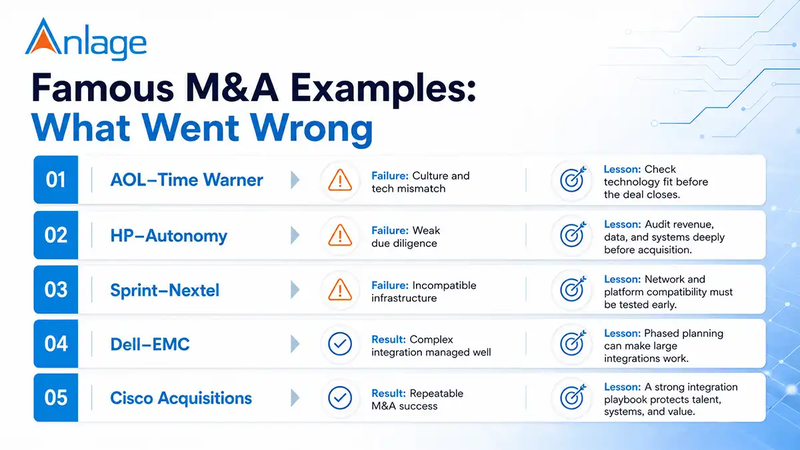
AOL and Time Warner (2000) — $165 Billion, Cultural and Technology Collapse
AOL's acquisition of Time Warner remains the most cited M&A failure in history. The strategic logic was defensible: Time Warner's cable infrastructure combined with AOL's internet subscriber base looked like a dominant media-tech play. What collapsed was the technology and culture integration. AOL operated as an internet-first, fast-moving company. Time Warner ran on broadcast media economics and legacy systems. The two IT estates were incompatible in architecture and in operating philosophy. When the dot-com bubble burst, the combined entity recorded a $99 billion loss within two years. The lesson for enterprise leaders: technology due diligence is not a post-close activity. Incompatible architectures need to be surfaced and costed before the deal is signed.
HP and Autonomy (2011) — $11.7 Billion, Due Diligence Failure
Hewlett-Packard acquired UK enterprise software firm Autonomy for $11.7 billion with the intent of transforming HP from a hardware company into an enterprise software business. Within 18 months, HP took an $8.8 billion writedown after discovering that Autonomy had been booking hardware sales as software licensing revenue — a distinction that standard technical due diligence should have caught. The IT and data audit was insufficient. HP's failure is now taught in virtually every business school M&A course as the definitive case for rigorous application-level due diligence before any software acquisition.
Sprint and Nextel (2005) — $35 Billion, Incompatible Infrastructure
Sprint acquired Nextel for $35 billion in what was then the largest US wireless merger in history. The fundamental problem was technical: Sprint operated on CDMA network technology, Nextel on iDEN. The two networks were architecturally incompatible and were never successfully merged. Customers churned to Verizon and AT&T, and the deal is now the canonical example of what happens when infrastructure incompatibility is underestimated at the deal stage. For enterprise IT leaders: network, infrastructure, and application compatibility assessment must happen in diligence, not integration planning.
Dell and EMC (2016) — $67 Billion, Complex Integration Done Relatively Right
Dell's acquisition of EMC was the largest technology acquisition in history at the time. Unlike the failures above, Dell approached the IT integration with a structured, phased methodology — consolidating data from different sources using ETL pipelines, mapping EMC's systems to Dell's infrastructure progressively, and maintaining operational continuity throughout. It was not seamless, but it demonstrated that large-scale IT integration is achievable when it is treated as a program, not a project. The key differentiator was early integration planning, which began before the deal closed.
Cisco — Serial Acquirer, Consistent IT Integration Playbook
Cisco has completed over 200 acquisitions and is one of the few enterprises that has turned M&A into a repeatable capability. Up to 87% of key employees from acquired companies remain with Cisco for more than two years — a retention rate that directly reflects the quality of its integration methodology. Cisco's approach standardizes the IT integration playbook across deals: early assessment of acquired technology, rapid application rationalization, and deliberate talent retention programs. For enterprise leaders evaluating their own M&A approach, Cisco is the benchmark for what a mature acquisition capability looks like.
What M&A Examples in India Tell Us
India's M&A market is growing rapidly, particularly in technology, BFSI, and healthcare. According to EY's M&A technology integration research, 96% of CIOs say they are or will be involved in a corporate transaction — yet only 37% are engaged in the post-close phase, which is where integration value is made or lost.
Domestic Indian examples illustrate the same dynamics. The HDFC-HDFC Bank merger, one of the largest financial mergers in Indian corporate history, required a multi-year technology integration spanning core banking systems, data platforms, and regulatory reporting infrastructure across two organizations with fundamentally different IT architectures. Similarly, consolidation in the Indian telecom sector — most visibly Vodafone-Idea — demonstrated that network and data integration complexity can overwhelm even deals with sound strategic logic.
Why 70% of M&A Deals Fail: The IT and Data Integration Problem
The 70–75% failure rate widely cited across M&A research is not primarily a finance problem. It is an integration problem — and at the center of that integration problem is technology. EY's research found that technology is the third-highest transaction cost driver, accounting for 2.5% of deal value. More significantly, acquirers with a formal Integration Management Office staffed and operating at signing achieved 1.8 times the synergy capture of those who stood up the integration function after close.
The specific failure points that enterprise IT leaders encounter in post-merger integration are consistent across industries:
Application estate rationalization — merged companies almost always have overlapping software. ERP systems, CRM platforms, data warehouses, and collaboration tools duplicate across both entities. Without a structured inventory and rationalization plan, enterprises end up paying double licenses, managing competing platforms, and generating technical debt that outlasts the integration timeline by years.
Data migration and master data management — consolidating customer records, financial data, product data, and operational data from two organizations with different schemas, data quality standards, and governance frameworks is one of the most complex technical exercises in enterprise IT. Schemas rarely match. Duplicates are endemic. Without a master data management strategy established before migration begins, data integrity problems compound.
Application modernization pressure — M&A frequently surfaces legacy applications that were being maintained in isolation at one or both entities. The integration moment is when those applications become blockers — either to the combined entity's new operating model or to regulatory compliance. Enterprises that treat M&A as an opportunity to modernize their application estate alongside integration capture significantly more value than those that lift-and-shift legacy systems into a merged architecture.
Cultural and talent integration — technology integration does not happen without people. The engineers, data architects, and IT leaders who understand the acquired company's systems are the most critical assets in the first 12 months post-close. Enterprises that lose those people during integration lose institutional knowledge that cannot be recovered from documentation.
What Are the Most Active M&A Sectors in 2025?
Technology, BFSI, healthcare, and retail are the most active M&A sectors globally as of 2025. Within technology specifically, the dominant driver is AI capability acquisition — enterprises are buying AI-native firms to embed capabilities they cannot build fast enough organically. According to Solganick's IT services M&A research, generative AI, applied ML, and agentic AI acquisitions dominated deal activity through 2025, with IBM's $11 billion acquisition of Confluent and Capgemini's $3.3 billion WNS deal among the largest. Cybersecurity M&A reached 111 deals in Q3 2025 alone. The pattern is clear: enterprises are using M&A to close capability gaps in AI and data that organic development cannot address at the required speed.
The Bottom Line
The M&A examples that endure as cautionary tales — AOL-Time Warner, HP-Autonomy, Sprint-Nextel — share a common thread. The strategic rationale was defensible. The IT and data integration was not planned with sufficient rigour, started too late, or was structurally incompatible from the outset. The examples that succeed — Cisco's acquisition machine, Dell-EMC's phased integration — demonstrate that M&A value is created in the integration phase, not the negotiation room.
For enterprise leaders, the actionable implication is straightforward: technology due diligence, application rationalization planning, and data integration strategy must be live workstreams before a deal closes — not workstreams that begin on Day 1 of integration.
How Anlage Digital Helps Enterprises Navigate Post-M&A Integration
Post-merger IT integration is where Anlage Digital's application development and data engineering practices are most directly relevant. Enterprises going through M&A face two parallel challenges: rationalizing the acquired application estate and consolidating disparate data platforms — both of which require experienced practitioners, not just project managers.
- Application rationalization and modernization — identifying overlapping systems, retiring legacy applications, and rebuilding where necessary on modern, cloud-native architecture
- Data platform consolidation — mapping source schemas, standardizing master data definitions, and building unified data pipelines across merged entities
- Post-merger application development — building net-new capabilities that the combined entity requires but neither legacy estate supports
- Cloud migration as part of integration — using the M&A integration moment to modernize infrastructure, not just replicate it at larger scale
- Managed services continuity — maintaining operational stability across both estates while integration work runs in parallel
With 28+ years of enterprise experience and delivery teams that have worked through complex IT integrations across BFSI, Retail, and Healthcare, Anlage brings the technical depth and operating discipline that post-merger integration demands.
If your organization is navigating or planning an M&A integration, talk to an Anlage expert about how we approach application and data consolidation.
Frequently Asked Questions
1. What are mergers and acquisitions with examples?
A merger combines two companies into one; an acquisition is when one company buys another and takes ownership. Famous examples include Dell-EMC ($67B), AOL-Time Warner ($165B), and Cisco's 200+ acquisitions.
2. What are some famous M&A examples?
The most studied are AOL-Time Warner (technology and culture collapse), HP-Autonomy ($8.8B writedown from due diligence failure), Sprint-Nextel (incompatible network infrastructure), and Dell-EMC (large-scale integration done with relative discipline).
3. Why do 70% of M&A deals fail?
Most failures happen post-close, not at deal stage — driven by technology incompatibility, poor data migration planning, and application estate duplication. All are avoidable with integration planning that starts before the deal closes.
4. What are the most active M&A sectors?
Technology, BFSI, healthcare, and retail lead globally in 2025. AI capability acquisition is the dominant driver — enterprises are buying AI-native firms to close capability gaps faster than organic development allows.
Build Your Innovation GCC in India
Anlage has set up 350+ GCCs across Retail, BFSI, Healthcare, and Technology. We can have your first team operational in 60 days.
Start the Conversation