
India does not just host Global Capability Centers — it has become the strategic nerve center for how the world's largest enterprises build, run, and evolve their core capabilities. According to the NASSCOM-Zinnov GCC Landscape Report, India now hosts over 2,100 GCCs employing nearly 2.36 million professionals, with the sector generating $76 billion in direct economic output in FY2025. By 2030, that figure is projected to cross $100 billion.
But headline numbers tell only part of the story. The more important question — particularly for enterprise leaders evaluating or scaling their India presence — is what actually separates a high-performing GCC from one that stagnates at cost-center status. This article examines the top GCC companies in India, what they do differently, and the operating principles that define genuine capability center excellence.
What Are GCC Companies?
A GCC company, in the context of India, refers to a global enterprise that has established a Global Capability Center — a captive offshore unit wholly owned and operated by the parent organization to deliver strategic functions including technology, engineering, analytics, finance, AI, and operations.
The term is often used interchangeably with Global In-house Center (GIC) or captive center. What fundamentally distinguishes a GCC from outsourcing is ownership and accountability. A GCC is staffed by the parent company's own employees, operates under its direct governance, and is evaluated against the enterprise's own strategic KPIs — not a vendor SLA. For a detailed breakdown of how this model has evolved, see our guide on what a GCC is and how it works.
The mandate has shifted dramatically over the past decade. According to Zinnov's Mega GCC Report, nine out of ten Mega GCCs now operate as Portfolio or Transformation hubs — the highest maturity classification — owning end-to-end charters including new digital platform development, global compliance programs, and multi-market product rollouts. What began as a cost arbitrage exercise has become a strategic architecture decision.
Which Companies Have GCCs in India?
The breadth of GCC companies operating in India spans virtually every global industry vertical. Here is a representative view of the most significant ones.
Technology
Microsoft operates one of its largest engineering centers globally in Hyderabad, with over 10,000 employees working across cloud infrastructure, product development, and AI research. The center owns engineering mandates for Azure, Teams, and Bing that ship to global markets — it is not a support function. Google runs its India GCC across Bengaluru and Hyderabad, contributing to core Search infrastructure and Google Maps. Amazon's Hyderabad center covers AWS infrastructure, Alexa, and supply chain engineering, and ranks among Amazon's largest technology hubs outside North America.
Financial Services
JPMorgan Chase operates large GCCs in Mumbai and Bengaluru running trading systems, risk analytics, and compliance operations — functions that are mission-critical, not peripheral. Goldman Sachs runs its Bengaluru center as a core delivery arm for technology, operations, and finance. American Express has had a GCC in India since the early 2000s, which has evolved from back-office processing to digital product development and real-time fraud analytics. BFSI represents approximately 40% of total Mega GCC talent in India, driven by regulatory complexity and data-sensitivity requirements that demand in-house ownership rather than vendor relationships.
Retail and Consumer
Walmart Global Tech in Bengaluru is one of the company's largest technology centers globally, driving e-commerce architecture, supply chain AI, and customer experience engineering. Nike runs a GCC focused on digital product innovation and consumer experience, and has progressively given its India team ownership of global platform initiatives.
Healthcare and Life Sciences
UnitedHealth Group operates one of the largest healthcare GCCs in India through Optum, employing over 35,000 professionals across analytics, technology, and clinical operations — a clear signal of how deeply GCCs have penetrated regulated industries that once resisted offshore models. Philips runs an India GCC focused on medical device software and healthcare AI.
What is notable across these examples is not just their scale — it is their maturity classification. These are not centers doing work that could be done anywhere. They are centers doing work the enterprise has explicitly chosen to own.
The GCC Maturity Spectrum: From Delivery Center to Innovation Hub
Not all GCCs are created equal, and the distinction matters significantly when evaluating what a high-performing GCC actually looks like. Zinnov's GCC maturity framework identifies four stages: Support Hub, Shared Services, Portfolio Hub, and Transformation Hub.
Most GCCs enter India as Support Hubs — executing well-defined, process-oriented tasks with clear SLAs and limited strategic autonomy. The ones that reach Transformation Hub status are running global product roadmaps, owning IP, and contributing directly to P&L outcomes. According to the Zinnov 2025 GCC Landscape analysis, global leadership roles from India have grown at a 40% CAGR over the past five years, reaching 6,500+ roles in 2024 — a structural signal of the maturity shift underway.
The gap between these stages is not primarily a question of budget or brand. It is a question of operating model, governance, and strategic intent — decisions made at the inception of the GCC, not retrofitted later.
What the Best GCC Companies in India Have in Common
After examining patterns across India's highest-performing GCCs — and drawing on data from NASSCOM, Zinnov, and direct operating experience — five characteristics consistently define the centers that outperform.
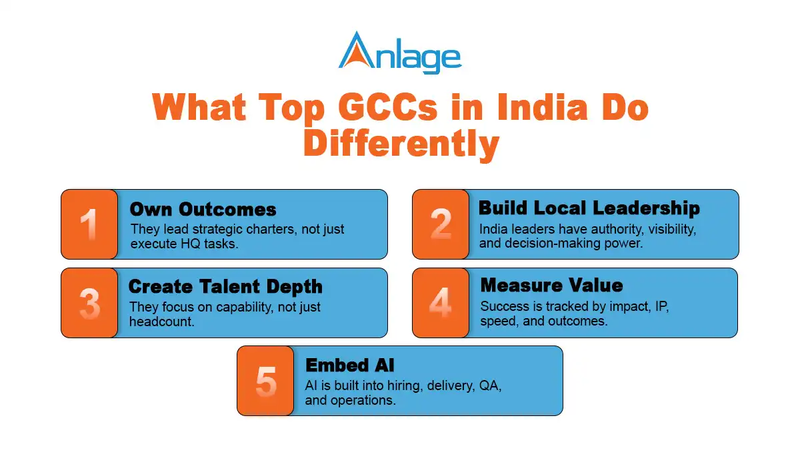
1. They Give India Real Ownership, Not Delegated Execution
The most important differentiator between a high-performing GCC and a stagnating one is whether the India team owns outcomes or merely executes instructions. According to the Zinnov-NASSCOM Mid-Market GCC report, over 60% of product and platform charters are now driven entirely from India at the top-performing GCCs. These teams are not receiving product specifications from HQ — they are writing them. The practical implication: if your GCC does not have end-to-end accountability for at least one strategic domain, it is being underutilized.
2. They Invest in India-Based Leadership as a Strategic Asset
GCCs that plateau are typically characterized by rotating HQ-appointed leaders with limited India context, and India-based managers with operational authority but no strategic voice. The best GCC companies resolve this by appointing India leaders with genuine P&L visibility, board-level access, and the mandate to hire and promote based on capability. Zinnov's data shows that 6,500+ global leadership roles are now based in India, growing at a 40% CAGR — the direct output of deliberate leadership investment, not organic evolution.
3. They Build Talent Depth, Not Just Headcount
India produces 2.5 million STEM graduates annually — the second-largest output globally. Volume has never been India's constraint. What separates the best GCC companies is how they convert that volume into institutional depth. Structured internal mobility programs, AI-assisted hiring that identifies best-fit rather than first-available candidates, university partnerships for specialized AI and ER&D roles, and mentoring ecosystems that retain institutional knowledge — these are the levers that determine whether a GCC scales with capability or merely with headcount.
4. They Measure Value, Not Activity
Low-performing GCCs are measured on headcount, hours logged, and SLA adherence. High-performing GCCs are evaluated on time-to-market, IP created, revenue influenced, and cost-per-outcome. This is not simply a reporting change — it fundamentally changes how teams are structured, how decisions are made, and what kind of talent the center attracts and retains. Enterprise leaders who still evaluate their GCC primarily on cost savings are optimizing for the wrong variable. The GCC's real competitive advantage is velocity and capability density.
5. They Treat AI Integration as an Architectural Decision, Not a Roadmap Item
The GCCs pulling ahead in 2026 built AI into their operating model from the start — not as a pilot or a future initiative. AI-assisted talent acquisition, automated QA pipelines, GenAI-enabled software delivery, and intelligent workflow automation are standard practice. A GCC that deploys AI on existing processes scales linearly. One that redesigns processes around AI scales exponentially. For more on how this is reshaping the landscape, our analysis of GCC market trends and the AI integration shift covers this in detail.
The Bottom Line
India's GCC ecosystem is no longer a cost arbitrage story. The best GCC companies in India — from Microsoft and Goldman Sachs to Walmart Global Tech and Optum — have turned their India centers into genuine innovation engines. What separates them is not budget or brand. It is governance, leadership investment, talent strategy, and a willingness to give India-based teams real ownership of real outcomes.
For global enterprises evaluating India, the question is no longer whether to set up a GCC — it is how to build one that delivers from day one, not year three. Understanding how GCCs compare to outsourcing models is a useful starting point for that decision.
How Anlage Digital Helps You Build a High-Performing GCC
Setting up a GCC in India is no longer the hard part. What is genuinely difficult is building one that matures — moving from Support Hub to Portfolio Hub within 18–24 months rather than remaining a cost center indefinitely. Anlage Digital's GCC-as-a-Service model is purpose-built to compress that maturity curve.
- End-to-end GCC lifecycle management — entity formation, workspace, legal compliance, and payroll, all under one roof
- AI-powered talent acquisition through Select10x — finds best-fit candidates, not first-available, from a 30 million-strong talent database
- Governance frameworks designed for outcome measurement from day one — not activity tracking or SLA management
- First team operational in under 60 days — without compromising on hiring quality or compliance
- 28+ years of enterprise experience and 350+ GCCs delivered across BFSI, Retail, Healthcare, and Technology
- Practitioners who have built and run GCCs from the inside — not consultants who advise from the outside
If you are evaluating India for the first time or looking to transform an existing center into a genuine capability hub, talk to an Anlage expert — we'll listen first and advise second.
Frequently Asked Questions
1. What are GCC companies?
GCC companies are global enterprises that have set up captive offshore units — called Global Capability Centers — to deliver strategic functions such as technology, AI, and engineering. Unlike outsourcing, GCCs are wholly owned by the parent enterprise and governed directly by its leadership.
2. Which companies have GCCs in India?
The most prominent include Microsoft, Google, Amazon, JPMorgan Chase, Goldman Sachs, Walmart Global Tech, and UnitedHealth Group (Optum). Nearly every Fortune 500 company with a significant technology or operations function has either established or is actively planning a GCC in India.
3. Is Deloitte a GCC company?
No — Deloitte is a professional services firm and third-party vendor, not a captive operation. Engaging Deloitte is outsourcing; a GCC is a wholly owned entity where the parent company retains full control over its people, processes, and IP.
4. Is Accenture a GCC in India?
No — Accenture is an IT services company that works for multiple clients, not a captive of one parent enterprise. Enterprises build GCCs specifically to retain ownership of talent and IP, which outsourcing to Accenture does not provide. See GCC vs outsourcing for a full breakdown.
Build Your Innovation GCC in India
Anlage has set up 350+ GCCs across Retail, BFSI, Healthcare, and Technology. We can have your first team operational in 60 days.
Start the Conversation