Enterprise AI has spent the last three years primarily inside screens — generating text, analysing data, powering chatbots. The next chapter is fundamentally different. Physical AI brings artificial intelligence into the real world: machines that can perceive their environment, reason about what they observe, plan a course of action, and execute it physically. According to NVIDIA CEO Jensen Huang at CES 2025, "The ChatGPT moment for robotics is here" — a statement that reflects not ambition, but commercial reality already arriving in manufacturing floors, hospital corridors, logistics warehouses, and construction sites globally.
The global physical AI market was valued at $3.5 billion in 2025 and is projected to reach $58.1 billion by 2035, growing at a CAGR of 32.4% according to MarketsandMarkets. For enterprise leaders, this is not a technology trend to monitor. It is a strategic capability decision to make now.
What is Physical AI?
Physical AI is the integration of artificial intelligence into physical systems — robots, autonomous machines, and intelligent infrastructure — that can perceive the real world through sensors, reason about what they observe, plan actions, and execute them in physical environments without being explicitly programmed for each task.
Unlike conventional robotics, which operates on fixed instructions and predefined rules, physical AI systems learn from data, adapt to new environments, and improve through experience. A physical AI system does not simply follow a script — it understands context, handles variability, and makes decisions in real time. The underlying technologies include computer vision, sensor fusion, reinforcement learning, natural language processing, and world foundation models that give machines a grounded understanding of how the physical world behaves.
NVIDIA, which has emerged as the defining platform for physical AI infrastructure, describes it as AI that can "perceive, reason, plan and act" — a four-stage capability stack that distinguishes physical AI from both conventional robotics and purely digital AI systems.
How Physical AI Works: The Four-Stage Stack
Understanding what physical AI does in practice requires understanding its four operational layers.
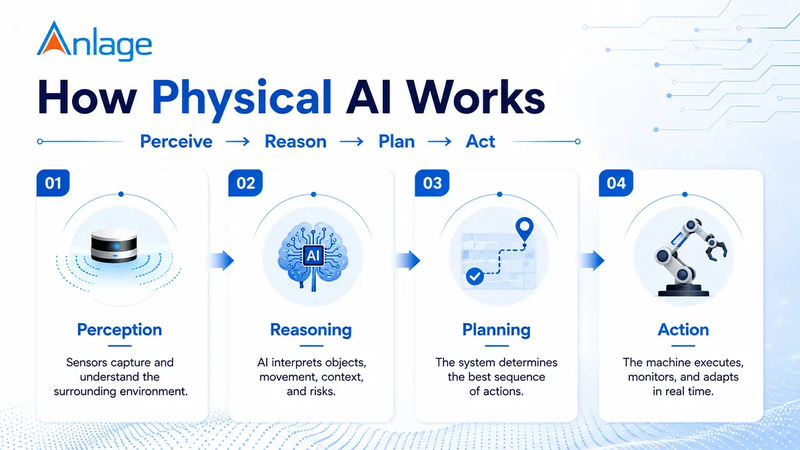
1. Perception
Physical AI systems use cameras, LiDAR, radar, and tactile sensors to build a real-time model of their environment. Computer vision remains the dominant perception modality, accounting for approximately 45% of physical AI market revenues in 2025. The perception layer answers the question: what is the machine seeing and sensing right now?
2. Reasoning
Once the environment is perceived, physical AI systems apply foundation models — large AI models trained on vast amounts of real-world and simulated data — to reason about what they observe. NVIDIA's Cosmos Reason, for example, is a reasoning vision language model purpose-built to understand physics, object permanence, and spatial-temporal relationships. The reasoning layer answers: what does this mean, and what are the options?
3. Planning
Physical AI systems generate action plans — sequences of physical movements or decisions — that accomplish a defined objective while navigating constraints in the environment. Planning must account for dynamic, unpredictable real-world conditions: humans moving through a warehouse, components arriving slightly off-spec, environmental changes during operation.
4. Action
The action layer is where physical AI meets the physical world: a robot arm assembling a component, an autonomous vehicle navigating an intersection, a warehouse bot rerouting around an obstacle. The action must be executed with precision, within safety thresholds, and with the ability to adapt in real time if conditions change.
This four-stage stack — perceive, reason, plan, act — is what makes physical AI categorically different from any prior generation of industrial automation.
Why Physical AI Matters for Enterprise Leaders in 2026
Physical AI is not a future technology. It is a present-day operational capability that is already reshaping competitive dynamics in manufacturing, logistics, healthcare, and retail. The enterprises that have moved from pilot programs to operational deployment are seeing structural advantages that cannot be replicated by those still running conventional automation.
Labor economics are shifting irreversibly. Global labor shortages in manufacturing, logistics, and healthcare are not cyclical — they are structural, driven by demographic shifts in developed economies. Physical AI systems can operate continuously, at consistent quality, without the constraints of shift patterns, fatigue, or labor market availability. Samsung Electronics announced in early 2026 a strategy to transition all manufacturing operations to AI-driven factories by 2030.
Simulation has eliminated the deployment risk that once made robotics unviable. One of the historical barriers to enterprise robotics was the cost and risk of developing and testing robot behaviors in the physical world. Physical AI changes this through digital twin simulation — creating a photorealistic virtual replica of the physical environment where robots can be trained across millions of scenarios before a single unit is deployed. NVIDIA's Omniverse platform is now the leading infrastructure for this simulation layer, used by ABB, FANUC, KUKA, and Yaskawa for robotics validation workflows.
The edge compute infrastructure has matured. Physical AI requires on-device inference — real-time decision-making that cannot depend on round-trip cloud latency when a robot arm is moving at industrial speed. NVIDIA's Jetson Thor platform, launched in 2025, provides the edge AI compute capable of running multimodal reasoning models directly within the robot. On-device deployment held 71% of physical AI market share in 2025, reflecting the engineering reality that local inference is the default architecture for physical systems.
Foundation models have crossed the generalization threshold. Prior robotic systems needed to be explicitly programmed for each task — move object A from position B to position C under conditions D. Physical AI foundation models, trained on vast datasets of real-world and simulated interactions, enable robots to generalize: to handle tasks they have not been explicitly programmed for, to adapt when conditions change, and to learn new behaviors from a small number of demonstrations rather than millions of training examples.
Physical AI in Practice: Enterprise Applications by Industry
Physical AI is not a single use case. It is a capability layer that applies differently across industries, and the enterprises capturing the most value are those that have identified the highest-leverage application within their specific operating environment.
Manufacturing — AI-powered vision systems performing real-time quality inspection at speeds and accuracy levels impossible for human operators. Adaptive assembly robots that adjust to variations in component dimensions. Human-robot collaboration where physical AI handles precision-critical or ergonomically hazardous tasks while human operators manage exception handling and process oversight.
Logistics and Supply Chain — autonomous mobile robots (AMRs) navigating dynamic warehouse environments, rerouting in real time around human workers and inventory changes. Physical AI-enabled picking systems that handle unstructured object varieties — the "any-SKU" picking problem that has historically been the hardest robotics challenge in e-commerce fulfillment.
Healthcare — surgical assistance robots that enhance precision in minimally invasive procedures. Autonomous medication dispensing and patient transport systems that reduce clinical staff burden on non-clinical tasks. AI-enabled diagnostic imaging robots that position patients and capture images without radiographer involvement.
Infrastructure and Smart Cities — physical AI vision systems monitoring industrial facilities for safety compliance, detecting anomalies in real time. Autonomous inspection drones assessing infrastructure — bridges, pipelines, transmission lines — in environments too hazardous or time-consuming for human inspection teams.
NVIDIA's Role: The Enabling Platform for Physical AI
No discussion of physical AI is complete without understanding NVIDIA's structural position. NVIDIA has built a full-stack platform for physical AI that spans GPU compute infrastructure, edge AI hardware (Jetson), simulation environments (Omniverse, Isaac Lab), and open foundation models (Cosmos, Isaac GR00T) — effectively occupying the same enabling layer in physical AI that cloud infrastructure providers occupy in enterprise computing.
At CES 2026, NVIDIA announced Cosmos Predict 2.5, Cosmos Reason 2, and Isaac GR00T N1.6 — open models covering world simulation, reasoning vision, and humanoid robot control respectively. Global robotics leaders including Boston Dynamics, Agility Robotics, Franka Robotics, and NEURA Robotics are building their platforms on this stack. For enterprise leaders evaluating physical AI deployment, NVIDIA's ecosystem is not one option among many — it is the dominant infrastructure layer on which most deployments are built.
The Bottom Line
Physical AI is the convergence of decades of progress in robotics, AI, simulation, and edge compute arriving simultaneously at commercial viability. The technology has crossed the threshold: it works at industrial scale, it is deployable without custom hardware development for most use cases, and the simulation infrastructure means the risk profile of deployment is manageable for enterprises with the right implementation partner.
For enterprise leaders, the strategic question is not whether physical AI will be relevant to their operations — it is whether they build the capability to deploy it before their competitors do. The window for first-mover advantage in AI-driven manufacturing, logistics, and healthcare operations is narrow and closing.
Building a physical AI capability requires specialized AI talent, GPU-scale infrastructure, and the systems integration expertise to connect AI models to physical machines in production environments — which is precisely where the right enterprise AI partner matters most.
How Anlage Digital Helps Enterprises Deploy Physical AI
Anlage Digital's AI Services practice and NVIDIA AI partnership are purpose-built for enterprises building physical AI capabilities — from initial feasibility assessment through to production deployment and managed operations.
- Physical AI readiness assessment — evaluating your current infrastructure, data environment, and operational use cases to identify where physical AI delivers the highest near-term ROI
- NVIDIA platform implementation — deploying and integrating NVIDIA Jetson edge compute, Isaac simulation environments, and Cosmos foundation models for your specific industrial application
- AI talent acquisition — sourcing specialized AI engineers, robotics integration specialists, and data scientists through Anlage's Select10x platform and a 30 million-strong talent database
- Digital twin development — building simulation environments that allow physical AI systems to be trained and validated before physical deployment, dramatically reducing deployment risk
- GCC build for AI capability — setting up a dedicated AI engineering center in India for enterprises that want to own their physical AI development capability long-term, with talent hub expertise built in from day one
- End-to-end managed AI operations — running the physical AI infrastructure after deployment, with continuous model improvement and performance monitoring
With 28+ years of enterprise technology experience and a direct partnership with NVIDIA, Anlage bridges the gap between physical AI's technological potential and operational deployment at enterprise scale.
If your organization is evaluating physical AI for manufacturing, logistics, healthcare, or infrastructure operations, talk to an Anlage AI expert to understand what deployment looks like for your specific environment.
Frequently Asked Questions
1. What is physical AI?
Physical AI is the integration of artificial intelligence into robots, autonomous machines, and intelligent infrastructure that can perceive, reason, plan, and act in the real world. Unlike conventional automation, physical AI systems learn from data and adapt to new environments without explicit reprogramming.
2. What is an example of physical AI?
A warehouse robot that navigates dynamically, avoids human workers, and picks varied products without fixed programming is physical AI. Other examples include AI-assisted surgical robots, autonomous inspection drones, and humanoid robots assembling electronics on a factory floor.
3. What is the difference between AI and physical AI?
Conventional AI operates in digital environments — generating text, analysing data, classifying images. Physical AI operates in the real world, where outputs are physical actions requiring on-device inference and real-time handling of unpredictable environments.
4. Why is NVIDIA central to physical AI?
NVIDIA provides the full-stack infrastructure most physical AI deployments are built on — GPU compute, Jetson edge processors, Omniverse simulation, and open foundation models including Cosmos and GR00T. It holds the same enabling position in physical AI that cloud providers hold in enterprise computing.
5. How can enterprises start deploying physical AI?
The most practical entry point is a use-case assessment identifying where physical AI delivers the clearest ROI — typically quality inspection, warehouse automation, or predictive maintenance. A simulation-first approach using NVIDIA Omniverse then allows full validation before any physical deployment.
Build Your Innovation GCC in India
Anlage has set up 350+ GCCs across Retail, BFSI, Healthcare, and Technology. We can have your first team operational in 60 days.
Start the Conversation