

Agentic AI in HR refers to autonomous AI systems deployed within human resources functions — particularly talent acquisition — that can independently execute multi-step workflows including candidate sourcing, outreach, screening, interview scheduling, and shortlist generation without requiring human input at each step. Unlike AI copilots that assist recruiters, agentic AI acts on behalf of the recruiter: it identifies candidates, initiates contact, follows up, and surfaces qualified shortlists to hiring managers as an output rather than a prompt response.
According to SHRM State of AI in HR, 43% of organizations now use AI in HR tasks — up from 26% in 2024 — with recruiting ranked as the number one AI use case across all HR functions. More significantly, Gartner agentic AI report within their functions by mid-2026 — a shift from AI tools that suggest actions to AI agents that take them.
For enterprise CHROs and talent acquisition leaders, this is not a future scenario. It is the operating model taking shape now — and the gap between enterprises that have deployed it and those still evaluating it is already measurable in time-to-hire, cost-per-hire, and quality of hire.
What is Agentic AI in HR?
Agentic AI in HR is the deployment of autonomous AI agents within human resources workflows — systems that perceive inputs, reason about goals, plan sequences of actions, execute tasks across multiple tools and platforms, and deliver outcomes without continuous human direction. In talent acquisition specifically, agentic AI moves the recruiter's role from executing tasks to governing agent outputs.
The distinction from earlier AI tools is architectural. An AI resume screener responds to a query — you give it 500 applications, it returns a ranked list. An agentic AI recruiting system proactively identifies candidates who have not applied, initiates personalised multi-channel outreach, follows up based on response patterns, qualifies candidates through AI-led conversations, schedules interviews directly into hiring manager calendars, and delivers a shortlist with documented reasoning — autonomously, across the full workflow.
Why Agentic AI Is Reshaping Talent Acquisition in 2026
Three structural forces are making agentic AI in HR not just attractive but necessary for enterprise talent teams.
Recruiting productivity has hit a ceiling. TA budgets are flat — only 30% of companies expect budget growth in 2026 according to SHRM TA benchmarks. Recruiter headcount is not growing — only 24% of organizations plan to add TA staff. Yet hiring demand is not declining. The only way to maintain hiring velocity with flat resources is through AI-driven productivity amplification. SHRM data shows that TA professionals who actively use AI save a full working day per week — a productivity gain that directly addresses the resource-demand gap.
Speed to hire is now a competitive differentiator. The average time-to-fill for enterprise roles sits at 63.5 days according to SHRM 2026 benchmarks. In competitive talent markets — particularly for AI engineers, data scientists, cloud architects, and specialized technical roles — candidates who are 30 days into a hiring process are already in offer stages with competitors. Agentic AI compresses the sourcing-to-shortlist timeline from weeks to hours by running candidate identification, outreach, and qualification simultaneously rather than sequentially.
The talent pool for specialized roles is structurally small. AI adoption in HR doubled in a single year — from 26% to 43% between 2024 and 2025 according to SHRM — but the talent required to build and operate AI systems is growing far more slowly than demand for it. For enterprises building AI-capable GCCs and engineering centers, the competition for senior AI engineers, MLOps practitioners, and data architects is global. Agentic AI sourcing — which scans passive candidate pools across professional networks, technical communities, and open-source contribution histories — is the only model that operates at the speed and scale this talent competition requires.
How Agentic AI Works Across the Talent Acquisition Lifecycle
Candidate Sourcing
Agentic AI sourcing systems continuously scan talent databases, professional networks, GitHub repositories, academic publications, and open-source contribution histories to identify passive candidates whose demonstrated skills match role requirements — not just those whose resumes contain the right keywords. This moves hiring from inbound (waiting for applicants) to proactive (identifying best-fit candidates who have not yet considered the role).
For enterprises hiring in India's competitive GCC talent market, agentic sourcing from a structured database — rather than generic job board posting — is the difference between time-to-shortlist measured in days versus weeks. For more on what effective GCC talent acquisition looks like at scale, our guide covers the full strategy in depth.
Candidate Outreach and Qualification
Once identified, agentic AI systems initiate personalised multi-channel outreach — email, LinkedIn, SMS — calibrated to each candidate's profile, seniority, and likely priorities. Response handling is also agentic: the system interprets replies, answers candidate questions from a defined knowledge base, handles objections, and moves interested candidates into a qualification workflow without recruiter involvement.
AI-assisted recruiter messaging makes companies 9% more likely to make a quality hire compared to those with low AI messaging adoption, according to LinkedIn data. At scale, across hundreds of simultaneous candidate conversations, the compounding effect on pipeline quality is significant.
Interview Scheduling and Coordination
Interview scheduling is one of the highest-friction, lowest-value tasks in the recruiting workflow — coordinating availability across candidates, recruiters, and hiring managers across time zones. Agentic AI scheduling systems resolve this entirely: they access calendar systems, propose options to candidates, confirm times, send preparation materials, and handle rescheduling autonomously. For talent hubs across multiple geographies, this is particularly high-value — eliminating the overnight-turnaround scheduling delays that characterize cross-timezone hiring.
Shortlisting and Hiring Manager Delivery
The output of an agentic recruiting workflow is a qualified shortlist delivered to the hiring manager with documented reasoning — not a pile of CVs. Each candidate on the shortlist has been sourced, contacted, qualified, and assessed against role requirements by the agent. The hiring manager's interaction with the process begins at the shortlist, not at the application stack.
This fundamentally changes the hiring manager experience — and the recruiter's role. Recruiters become governors of agent quality rather than executors of agent tasks: reviewing shortlist reasoning, calibrating agent parameters, managing edge cases, and making the human judgements that determine final hire decisions.
Agentic AI vs Traditional AI Recruiting Tools
Dimension | Traditional AI Tools | Agentic AI |
|---|---|---|
Mode | Responds to recruiter queries | Acts autonomously on recruiter's behalf |
Sourcing | Screens inbound applications | Proactively identifies passive candidates |
Outreach | Assists recruiter in drafting | Executes multi-channel outreach independently |
Qualification | Scores and ranks | Conducts AI-led qualification conversations |
Scheduling | Suggests available slots | Books interviews directly into calendars |
Output | Ranked candidate list | Qualified shortlist with documented reasoning |
Recruiter role | Executes tasks with AI assistance | Governs agent outputs and decisions |
Speed | Faster than manual | Dramatically faster — parallel, not sequential |
Compliance burden | Moderate | Higher — autonomous decisions require governance |
The Governance and Compliance Dimension
Agentic AI in HR carries the highest regulatory risk of any HR technology deployment. The EU AI Act explicitly classifies recruitment AI as high-risk — meaning any AI system used to filter, rank, or screen candidates affecting EU users must meet conformity assessment requirements, maintain audit trails, and implement human oversight mechanisms. Fines reach €15 million or 3% of global annual turnover for non-compliance.
For enterprise talent acquisition teams, this creates three non-negotiable requirements:
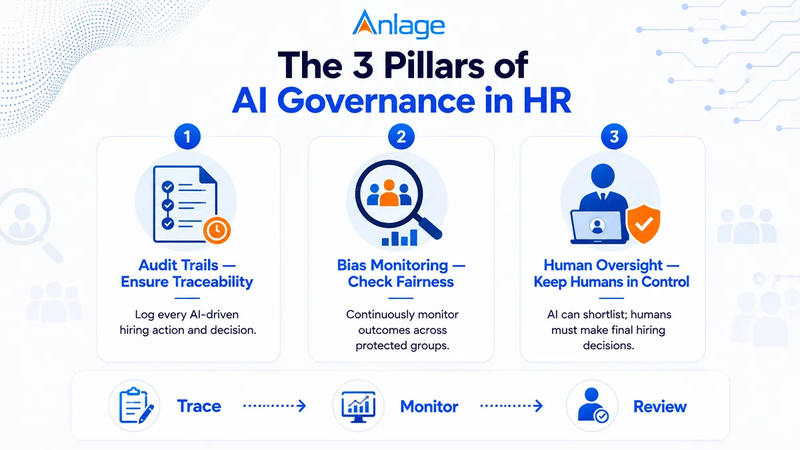
Audit trails. Every AI decision in the recruiting workflow — candidate ranked, outreach sent, qualification conclusion reached — must be logged with sufficient context to reconstruct the reasoning and demonstrate it did not discriminate on protected characteristics.
Bias monitoring. Agentic sourcing systems trained on historical hiring data will reproduce historical hiring patterns, including historical biases, unless actively corrected. Continuous monitoring of differential outcomes across gender, age, race, and disability status is not optional under the EU AI Act for high-risk systems.
Human override mechanisms. No agentic AI system in HR should make a final hiring or rejection decision without a defined human review checkpoint. The agent qualifies and shortlists; the human hires and rejects. This boundary must be architecturally enforced, not just stated in policy.
Enterprises that treat governance as an afterthought in agentic HR deployments will encounter regulatory exposure, candidate trust breakdown — Pew Research found 66% of Americans would not want to apply for a job with an employer that uses AI in hiring decisions — and the reputational cost of high-profile AI hiring failures that are becoming increasingly well-documented.
For enterprises evaluating how insourcing vs outsourcing affect talent strategy and where agentic AI fits within a broader GCC operating model, this governance architecture is a foundational consideration.
The Bottom Line
Agentic AI in HR is the operating model shift that separates enterprise talent teams running at 2026 velocity from those still running 2022 workflows. The data is unambiguous: AI adoption in HR doubled in a single year, 82% of HR leaders are implementing agentic AI, and the productivity, speed, and quality-of-hire advantages of agentic recruiting are documented and compounding. The governance challenge is real but solvable — and the enterprises that solve it first will have a structural advantage in the talent market that compounds over time.
The question is not whether agentic AI belongs in enterprise talent acquisition. It does. The question is whether the governance architecture, bias monitoring, and human oversight mechanisms are in place before the agents start making decisions at scale.
How Anlage Digital's Select10x Delivers Agentic HR
Anlage Digital's Select10x is purpose-built for enterprise talent acquisition at GCC scale — combining agentic AI sourcing, skills-based assessment, and governance infrastructure in a single platform.
- Agentic candidate sourcing — proactively identifying best-fit candidates from a 30 million-strong talent database using skills-based matching, not keyword filtering
- Multi-channel autonomous outreach — personalised candidate outreach executed by the agent across email and professional networks, with response handling and qualification built in
- AI-led skills assessment — evaluating candidates against role-specific competency frameworks before they reach the hiring manager's shortlist
- Bias-aware screening — built-in governance controls and audit trails that meet EU AI Act compliance requirements for high-risk recruitment AI
- Human-in-the-loop architecture — defined review checkpoints that ensure human oversight at every decision point where EU AI Act or enterprise policy requires it
- Workforce analytics — real-time pipeline visibility, source effectiveness, and quality-of-hire metrics for CHROs and TA leaders
With 28+ years of enterprise experience and 350+ GCCs delivered, Anlage brings the talent market depth and AI governance infrastructure that agentic enterprise recruiting demands.
If your organization is building or scaling a GCC talent acquisition capability and wants to understand what agentic AI recruitment looks like in practice, talk to an expert — we will map the right architecture for your hiring volume, role complexity, and compliance environment.
Frequently Asked Questions
1. What is agentic AI in HR?
Agentic AI in HR refers to autonomous systems that independently source, outreach, qualify, and schedule candidates without human input at each step. Unlike AI tools that assist recruiters, agentic AI acts on their behalf across the full workflow.
2. How does agentic AI differ from traditional AI recruiting tools?
Traditional AI tools respond to recruiter queries — screen applications when asked, suggest candidates when prompted. Agentic AI proactively sources passive candidates, runs autonomous outreach, and delivers a qualified shortlist as the output.
3. What are the compliance risks of agentic AI in recruiting?
The EU AI Act classifies recruitment AI as high-risk with fines up to €15M, requiring audit trails, bias monitoring, and human oversight. Every agent decision must be logged and subject to human review before a final hiring or rejection decision is made.
4. How much faster is agentic AI recruiting vs traditional methods?
Agentic AI compresses sourcing-to-shortlist from weeks to hours by running identification, outreach, and qualification simultaneously rather than sequentially. SHRM data shows TA professionals using AI save a full working day per week — agentic systems amplify this further.
5. Is agentic AI in HR ready for enterprise deployment?
Yes — 82% of HR leaders plan to implement agentic AI by mid-2026 and 43% of organizations already use AI in HR. The technology is production-ready; governance infrastructure — audit trails, bias monitoring, human oversight — must be designed in from the start.
Build Your Innovation GCC in India
Anlage has set up 350+ GCCs across Retail, BFSI, Healthcare, and Technology. We can have your first team operational in 60 days.
Start the Conversation