
Every enterprise leader is under pressure to transform. But transformation is not a strategy — it is an outcome. The actual levers are digital transformation technologies: the specific tools, platforms, and infrastructure that change how an enterprise operates, delivers value, and competes. Getting clear on what these technologies are, how they relate to each other, and which ones to prioritise in which sequence is the foundational decision that determines whether a transformation program delivers measurable returns or becomes another expensive proof of concept.
The global digital transformation market was valued at $1.3 trillion in 2025 and is projected to reach $5.5 trillion by 2033, according to Grand View Research. Yet McKinsey's 2025 State of AI research found that despite nearly 90% of organizations regularly using AI, only 5.5% report meaningful EBIT impact. The gap between investment and outcome is not a technology problem. It is a clarity and sequencing problem — and this guide addresses both.
What Are Digital Transformation Technologies?
Digital transformation technologies are the tools, platforms, and infrastructure that enable enterprises to fundamentally change how they operate, deliver value to customers, and compete in their markets. They are not productivity tools that make existing processes marginally faster. They are foundational systems that change the operating model itself — enabling enterprises to do things that were structurally impossible with prior technology generations.
The category spans cloud infrastructure, artificial intelligence, data engineering platforms, automation, IoT, cybersecurity, and application modernization. What unifies them is intent: each digital transformation technology, when deployed correctly, enables a structural change in how the enterprise operates — not just an incremental efficiency gain. The distinction matters because it determines how these technologies should be evaluated, sequenced, and governed.
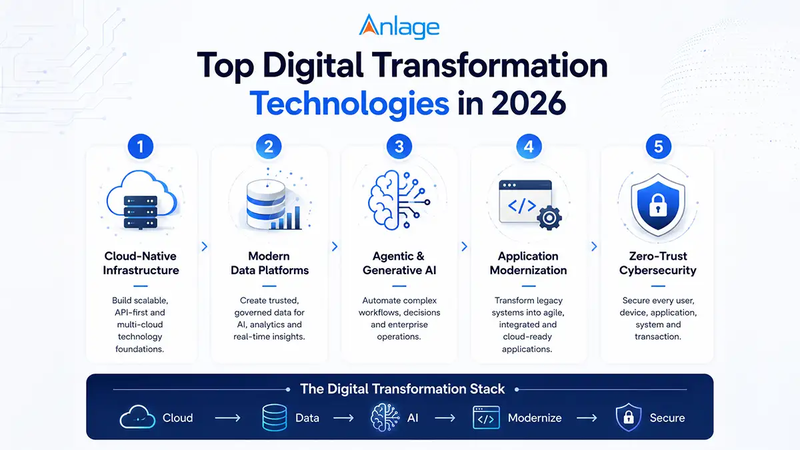
Digital transformation technologies work as a system, not a collection of independent investments. Cloud is the foundation. Data engineering is the connective tissue. AI is the intelligence layer. Application modernization connects legacy systems to the new stack. Cybersecurity governs the entire estate. Enterprises that treat these as separate procurement decisions, rather than an integrated architecture, consistently fail to generate transformation outcomes.
Why Digital Transformation Technologies Are a Board-Level Priority in 2026
The urgency is not new — but the competitive stakes have shifted significantly in the last 24 months. Three forces are driving digital transformation technologies to the top of the enterprise agenda in 2026.
The AI productivity gap is widening between early movers and the rest. Enterprises that have built mature AI and data infrastructure are now compounding their advantage — running AI-powered operations, product development, and customer engagement at a velocity that organizations still running conventional processes cannot match. The gap that McKinsey identified — where only 5.5% of organizations are generating meaningful EBIT impact from AI — reflects the divergence between enterprises that have the underlying data and cloud foundations that AI requires, and those that deployed AI tools on top of fragmented, poor-quality data and saw no material returns.
Regulatory environments are forcing technology architecture decisions. GDPR, DPDP in India, the EU AI Act, and sector-specific regulations in BFSI and healthcare are requiring enterprises to make explicit architectural choices about data residency, AI explainability, and system auditability. These are not IT decisions — they are enterprise risk decisions that require board-level clarity on which digital transformation technologies are in scope, how they are governed, and what the compliance architecture looks like.
Legacy application debt is compounding. Every year that an enterprise maintains monolithic, on-premise legacy systems is a year where the cost and complexity of the eventual modernization increases. The enterprises that have deferred application modernization are now facing a situation where their legacy estates are actively blocking AI and data platform deployment — because the integrations that AI models depend on cannot be built on systems that were not designed for them.
The Core Digital Transformation Technologies: What They Are and How They Relate
Cloud Infrastructure
Cloud is the foundational digital transformation technology — the platform on which every other capability in the transformation stack is built. Without cloud infrastructure, AI models cannot scale, data platforms cannot process at enterprise volume, and applications cannot be updated at the speed modern business requires.
The relevant distinction for enterprise leaders is between cloud migration and cloud-native architecture. Cloud migration moves existing systems to cloud infrastructure — the workloads run in the cloud but are often architecturally unchanged. Cloud-native means designing systems from the ground up for cloud: microservices, containerization, serverless compute, and API-first integration. Cloud-native architectures are significantly more agile, more cost-efficient at scale, and more capable of integrating with AI and data platforms than migrated legacy systems.
Multi-cloud strategy — distributing workloads across AWS, Azure, and GCP based on capability, cost, and regulatory requirements — has become the default architecture for large enterprises managing vendor concentration risk. The governance and FinOps discipline required to manage multi-cloud estates effectively is itself a core enterprise capability that most organizations are still building.
Artificial Intelligence and Agentic AI
AI is the intelligence layer of the digital transformation technology stack — the capability that allows enterprises to automate complex decisions, generate insights from data at scale, and build products and services that were impossible with prior technology. The frontier in 2026 has moved from generative AI to agentic AI: systems that autonomously execute multi-step workflows, make decisions across enterprise systems, and take actions without human intervention at each step.
The critical point for enterprise decision-makers is that AI is not a standalone digital transformation technology. It is dependent on the data infrastructure beneath it. Enterprises that have attempted to deploy AI on top of fragmented, poorly-governed data consistently fail to generate meaningful returns — which is precisely the pattern McKinsey identified in its 2025 research. AI deployment must be sequenced after the data foundation is in place, not before.
For enterprises evaluating where AI delivers the most immediate, measurable value: intelligent document processing, AI-assisted software development, demand forecasting, and predictive maintenance in manufacturing are the use cases with the most consistent track record of positive ROI at enterprise scale.
Data Engineering and Data Platforms
Data engineering is the digital transformation technology that most enterprises underinvest in and most consistently identify as the primary barrier to AI and analytics value. It covers the design and build of data pipelines, data lakes, data lakehouses, streaming infrastructure, and the governance frameworks that ensure data quality, lineage, and access control across the enterprise.
The modern data platform architecture in 2026 is the lakehouse: a unified platform that combines the low-cost, flexible storage of a data lake with the query performance, ACID compliance, and governance capabilities of a data warehouse. Databricks, Snowflake, and Microsoft Fabric are the dominant platforms in this space. What matters more than platform selection is the data quality and governance architecture that sits on top — a lakehouse built on poor-quality, ungovernanced data delivers the same outcomes as a data warehouse built on the same inputs.
Application Modernization
Application modernization is the digital transformation technology that unlocks the value of everything else. Legacy monolithic applications that cannot integrate with modern data platforms, AI APIs, or cloud-native services become the bottleneck that prevents enterprises from deploying the other digital transformation technologies effectively.
The most common modernization approaches are re-platforming (moving to cloud infrastructure without changing architecture), re-architecting (decomposing monoliths into microservices), and rebuilding (replacing legacy systems with new cloud-native applications). The sequencing decision depends on the legacy system's criticality, integration complexity, and the timeline within which the enterprise needs cloud-native capability.
The practical implication: application modernization should not be treated as a separate initiative from AI and data platform deployment. They are interdependent — modernization creates the integration surfaces that AI and data platforms need, and AI-assisted code analysis and migration tools materially reduce the cost and risk of large-scale modernization programs.
Cybersecurity and Zero-Trust Architecture
Cybersecurity is the digital transformation technology that governs the estate — and the one that is most consistently treated as an afterthought until a breach makes it unavoidable. Zero-trust architecture — where no user, device, or system is implicitly trusted and every access request is continuously verified — is the security framework required for enterprises running distributed, multi-cloud, AI-powered technology estates.
The governance dimension of cybersecurity has expanded significantly in 2026. AI systems introduce new attack surfaces and new explainability requirements. Data platforms create new data residency and access control obligations. Cloud infrastructure requires continuous misconfiguration monitoring. The enterprise that builds security and zero-trust principles into the architecture of its digital transformation technologies from day one is significantly more resilient — and significantly faster to recover — than the one that retrofits security onto a deployed estate.
How Digital Transformation Technologies Apply Across Industries
Digital transformation technologies are not generic — their application, sequencing, and priority differ significantly by industry. For context on how these technologies are reshaping enterprise operating models across different sectors, our analysis of the role of technology in Global Capability Centers and what physical AI means for enterprise innovation covers two of the most active application areas in depth.
BFSI — Core banking modernization, real-time payments infrastructure, AI-powered risk and compliance, and open banking API ecosystems are the primary digital transformation technology investments in financial services. Regulatory requirements around data residency, AI explainability, and audit trails make governance architecture a first-order concern alongside capability deployment.
Healthcare and Life Sciences — AI-enabled diagnostics, electronic health record modernization, real-time clinical data platforms, and IoT-connected medical devices are the defining digital transformation technologies in healthcare. HIPAA and MDR compliance requirements add significant architecture constraints that must be addressed at design stage, not during deployment.
Manufacturing and Industrial — Digital twins, IoT sensor networks, AI-powered quality inspection, predictive maintenance, and smart factory automation are transforming manufacturing operations. Industry 4.0 programs at the largest manufacturers — Siemens, Bosch, Honeywell — are fundamentally digital transformation technology programs at industrial scale.
Retail and Consumer — Demand forecasting AI, supply chain intelligence, personalization platforms, and omnichannel commerce infrastructure are the primary digital transformation technology investments in retail. The enterprises generating the most value are those that have unified their customer and operational data into a single platform that feeds both AI models and real-time operational systems.
The Sequencing Principle: Why Order Matters More Than Tool Selection
The most important insight from enterprises that have generated measurable returns from digital transformation technologies is sequencing. The tools matter less than the order in which they are deployed and the foundations they are built on.
The framework that consistently produces outcomes:
- Cloud infrastructure first — establish the scalable, governed foundation everything else runs on
- Data platform and governance second — build the data quality, lineage, and access control architecture before deploying AI
- AI and analytics third — deploy intelligence on top of clean, governed, integrated data
- Application modernization in parallel — create the integration surfaces that connect legacy systems to the new stack
- Cybersecurity embedded throughout — zero-trust principles built into every layer from day one, not retrofitted at the end
Enterprises that understand this as a GCC-anchored capability build — owning engineering, data, and AI talent in a captive structure rather than depending entirely on vendor-managed delivery — are building competitive advantages in digital transformation that are significantly harder to replicate than point technology deployments.
The Bottom Line
Digital transformation technologies are not the destination — they are the instruments through which the destination is reached. The enterprises generating measurable transformation outcomes are those that are clear on which technologies to deploy, in which sequence, on which foundations, and with which governance — not those that have deployed the most tools or spent the most capital.
For enterprise decision-makers, the most valuable clarity is architectural: understanding how cloud, AI, data, application modernization, and cybersecurity relate to each other as a system, and making sequencing decisions that build each layer on the right foundation. The $5.5 trillion projection for the digital transformation market by 2033 reflects a global enterprise commitment that is already well underway. The question is not whether to participate — it is whether to build the architectural discipline that makes participation productive.
How Anlage Digital Helps Enterprises Deploy Digital Transformation Technologies
Anlage Digital's cloud services, AI services, and data engineering practices cover the full digital transformation technology stack — from architecture design and platform selection through to deployment, integration, and managed operations.
- Cloud architecture and migration — designing multi-cloud, cloud-native infrastructure on AWS, Azure, and GCP with FinOps discipline embedded from day one
- AI and agentic AI deployment — building and operationalizing AI models with data quality assessment and governance built into the deployment architecture
- Data platform engineering — designing and implementing data lakehouses and governed data pipelines on Databricks, Snowflake, and Microsoft Fabric
- Application modernization — re-platforming and re-architecting legacy estates using phased, risk-managed approaches that maintain operational continuity
- Cybersecurity and zero-trust implementation — embedding security architecture across cloud, data, and AI deployments from design stage
- Digital transformation GCC build — setting up captive engineering centers in India for enterprises that want to own their digital transformation technology capability long-term
With 28+ years of enterprise experience across BFSI, Retail, Healthcare, and Manufacturing, Anlage brings the architectural depth and operating discipline that deploying digital transformation technologies at enterprise scale demands.
If your organization is at an early stage of evaluating which digital transformation technologies to prioritize, or is mid-program and facing sequencing or integration challenges, talk to an Anlage expert to map the right approach for your specific environment.
Frequently Asked Questions
1. What are digital transformation technologies?
Digital transformation technologies are cloud, AI, data engineering, IoT, and application modernization platforms that change an enterprise's operating model — not just its efficiency. They work as an integrated system, not as separate investments.
2. What is the most important digital transformation technology to invest in first?
Cloud infrastructure is the foundational investment — without it, AI cannot scale and data platforms cannot function at enterprise volume. Every other digital transformation technology depends on getting this layer right first.
3. Why do digital transformation programs fail?
Most programs fail because enterprises treat digital transformation technologies as procurement decisions rather than architectural ones. Sequencing and integration discipline — deploying AI only after data quality is fixed — determines outcomes more than tool selection.
4. How long does digital transformation take for an enterprise?
There is no fixed timeline — it depends on legacy complexity, organizational readiness, and scope. Enterprises following a phased approach — cloud first, then data, then AI — typically see measurable operational impact within 18–24 months.
5. What is the difference between digitization and digital transformation?
Digitization converts manual processes to digital format — scanning documents, for example. Digital transformation changes how an enterprise operates and competes, requiring full architectural change across cloud, data, and AI.
Build Your Innovation GCC in India
Anlage has set up 350+ GCCs across Retail, BFSI, Healthcare, and Technology. We can have your first team operational in 60 days.
Start the Conversation