AI governance auditing is the systematic process of evaluating an enterprise's AI systems against defined policies, regulatory requirements, and ethical standards — assessing whether AI models are performing as intended, producing fair and explainable outputs, maintaining data integrity, and operating within the legal and compliance boundaries the enterprise is accountable to. It is the difference between claiming responsible AI and being able to prove it.
The urgency is not theoretical. According to Gartner AI governance report, organizations that deploy AI governance platforms are 3.4 times more likely to achieve high effectiveness in AI governance than those that do not. AI governance compliance spend is projected to reach $492 million in 2026 and surpass $1 billion by 2030 as regulation extends to 75% of the world's economies. And Evolvance AI governance data show the governance gap starkly: 88% of organizations used AI in at least one business function in 2025, but only 8% maintain a comprehensive AI governance framework.
That gap — between AI deployment and AI accountability — is where regulatory fines, reputational damage, and operational failures concentrate.
What is AI Governance Auditing?
AI governance auditing is a structured evaluation process that assesses whether an enterprise's AI systems are designed, deployed, and operating in accordance with internal policies, regulatory requirements, and responsible AI principles. It covers the full AI lifecycle — from data sourcing and model training through deployment, monitoring, and retirement.
An AI governance audit examines four core dimensions:
1. Compliance — Are AI systems meeting the requirements of applicable regulation, including the EU AI Act, NIST AI Risk Management Framework, ISO/IEC 42001, sector-specific frameworks (FCA, EEOC, FDA), and data protection laws (GDPR, DPDP)?
2. Fairness and bias — Are AI models producing outputs that discriminate systematically against protected groups? Do training datasets reflect the population the model is deployed against?
3. Explainability and transparency — Can the enterprise demonstrate how an AI system reached a decision? Is that decision traceable, auditable, and comprehensible to regulators and affected individuals?
4. Security and data integrity — Are AI systems protected against adversarial inputs, data poisoning, and unauthorized access? Is sensitive data handled in compliance with data residency and access control requirements?
AI governance auditing is distinct from a one-time compliance check. The enterprises building mature AI governance programs are moving from periodic audits to continuous monitoring — where every AI decision is logged, scored against governance policies, and flagged for human review when thresholds are breached.
Why AI Governance Auditing Is Now Urgent
Three forces have made AI governance auditing non-negotiable for enterprise leaders in 2026.
The EU AI Act is fully in force. The EU AI Act became applicable on August 2, 2026, with the AI Office and national authorities now actively enforcing compliance. High-risk AI systems — those used in employment, critical infrastructure, education, essential services, and law enforcement — face conformity assessment requirements, mandatory technical documentation, and human oversight obligations. Fines for non-compliance reach €35 million or 7% of global annual turnover for the most serious violations. Enterprises operating AI systems that affect EU users are in scope regardless of where they are headquartered.
AI incidents are rising at pace. Stanford HAI's AI Incident Database logged 362 AI incidents in 2025, up 55% from 233 in 2024. Gartner projects that through 2026, at least 80% of unauthorized AI transactions will stem from internal policy violations — data oversharing, unacceptable use by employees — rather than external attacks. The risk is primarily inside the enterprise, not outside it.
The governance gap creates measurable business risk. According to IBM data cited by Evolvance, 87% of organizations claim they have clear AI governance frameworks — but fewer than 25% have fully implemented the controls needed to manage bias, transparency, and security risks. Claiming governance and running governance are two entirely different things. The Clearview AI facial recognition enforcement case resulted in a €30.5 million fine — an outcome that becomes more, not less, likely as AI Act enforcement machinery is now operational.
The AI Governance Audit Framework: What It Covers
A mature AI governance auditing program covers six interconnected layers. Enterprises that treat any one of these as optional create compliance exposure in the others.
1. AI System Inventory and Risk Classification
Before you can audit AI governance, you need to know what AI systems exist. Most enterprises have significant shadow AI — models deployed by individual teams without central visibility. A comprehensive AI inventory maps every AI system in production and development, classifies it by risk level (unacceptable, high, limited, minimal under the EU AI Act), and assigns ownership and accountability.
The inventory is the foundation of everything else. Without it, governance audits are sampling an unknown population. According to Gartner, enterprises with centralized AI inventories are significantly more effective at managing AI risk than those without.
2. Data Governance and Lineage
AI models are only as trustworthy as the data they are trained and operated on. AI governance auditing examines data provenance — where training data came from, how it was processed, whether consent was obtained — and data lineage, the ability to trace how data flowed through the AI system from source to output. For regulated industries — BFSI, healthcare, insurance — this is not optional. GDPR Article 22 and the EU AI Act both require that decisions affecting individuals through automated means can be explained and challenged.
3. Model Performance and Bias Testing
Auditing model performance requires more than tracking accuracy metrics. It requires systematic testing for differential performance across protected groups — gender, race, age, disability status — to identify where the model produces discriminatorily different outcomes. This is the dimension most likely to generate regulatory action: the EEOC, FCA, and EU AI Office have all issued guidance making bias testing a compliance requirement for AI systems used in employment, credit, and essential services.
4. Explainability and Audit Trails
Every AI decision that affects an individual or a business outcome must be traceable. This means maintaining immutable audit logs that record what decision was made, what inputs drove it, what model version produced it, and what data it was trained on. For high-risk AI systems under the EU AI Act, this is a hard requirement. For any enterprise using AI in BFSI, healthcare, or employment, it is a practical necessity for responding to regulatory inquiries and managing legal exposure.
5. Human Oversight Mechanisms
The EU AI Act requires that high-risk AI systems have human oversight mechanisms — the ability to interrupt, override, or correct AI decisions before they take effect. AI governance auditing assesses whether these mechanisms are designed into the system architecture, not bolted on after deployment. An AI hiring tool that produces a candidate ranking without a defined human review step before a decision is made is structurally non-compliant under the Act's employment provisions.
6. Continuous Monitoring and Incident Response
Model performance degrades over time as the real-world environment changes from the training environment — a phenomenon called model drift. AI governance auditing in a mature program is continuous, not periodic: runtime guardrails flag decisions that breach policy thresholds, continuous monitoring detects drift before it creates regulatory exposure, and incident response plans define how the enterprise identifies, contains, and reports AI failures. For AI capability in GCCs, embedding governance monitoring into GCC operations from the start is significantly more efficient than retrofitting it after deployment.
The Three Governance Frameworks Enterprises Are Implementing
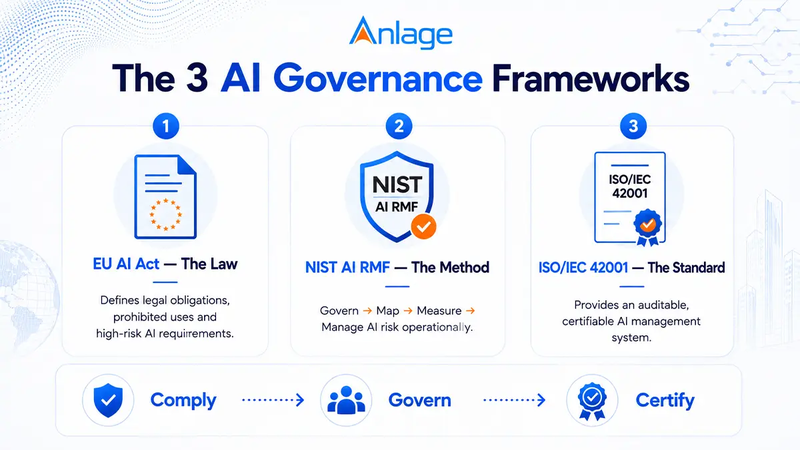
Three frameworks now define the governance landscape. They are designed to be used together, not chosen between.
EU AI Act — the law. It defines what is prohibited, what requires conformity assessment, and what transparency obligations apply. If your AI affects EU users, compliance is not optional. The August 2026 full application date means enforcement is now active.
NIST AI Risk Management Framework (AI RMF) — the operating method. A voluntary US framework organized into four functions: Govern (set policy and culture), Map (identify AI systems and risks), Measure (test and quantify), and Manage (act on and monitor). It has become the common operational language for enterprise AI governance teams globally, including outside the US.
ISO/IEC 42001 — the certifiable standard. An international standard for AI Management Systems that allows enterprises to certify their governance program to an auditable third-party standard — the AI equivalent of ISO 27001 for cybersecurity. Enterprises that are ISO/IEC 42001 certified can demonstrate governance capability to regulators, customers, and partners in a way that internal policy documents cannot.
For R&D centers in India, implementing governance frameworks at the GCC level — rather than only at HQ — is increasingly a requirement as GCCs own more end-to-end AI development mandates. And for organizations deploying physical AI — robotics, autonomous systems, industrial AI — EU AI Act high-risk classification makes governance auditing a legal prerequisite before deployment.
What Enterprises Get Wrong in AI Governance Auditing
Treating governance as a documentation exercise. The most common failure is producing policy documents, completing checklists, and calling it governance. IBM data shows 87% of organizations claim to have AI governance frameworks — but fewer than 25% have embedded the controls needed to actually manage bias, transparency, and security risks. The regulator does not read your policy document. It examines your audit logs.
Auditing AI in isolation from the broader data estate. AI governance cannot be separated from data governance. A model trained on poorly governed data — unverified, biased, or non-consented — cannot be made compliant by governance controls applied after training. The data foundation precedes the governance audit.
Periodic audits instead of continuous monitoring. A quarterly AI governance audit is functionally obsolete before the next one begins. Models drift. Inputs change. New use cases emerge. Mature AI governance programs run continuous monitoring — automated policy enforcement at runtime, not periodic retrospective review.
Overlooking shadow AI. Only 25% of enterprises report comprehensive visibility into employee AI use, according to Optro's research. AI deployed by individual teams — coding assistants, productivity tools, analytical models — creates governance exposure that a central audit program cannot address without a comprehensive AI inventory as its foundation.
The Bottom Line
AI governance auditing is the infrastructure that makes AI deployment sustainable at enterprise scale. Without it, every AI system the enterprise deploys is a latent regulatory, reputational, and operational risk. With it, enterprises can deploy AI faster, with more confidence, and with the evidentiary foundation required to respond to regulatory scrutiny.
The 3.4x governance effectiveness advantage Gartner identifies for enterprises with structured AI governance platforms reflects a simple reality: governance is not a drag on AI deployment — it is what enables AI deployment to scale without accumulating unmanaged risk.
How Anlage Digital Helps Enterprises Build AI Governance
Anlage Digital's AI services includes AI governance design and implementation — helping enterprises build the frameworks, technical controls, and operational processes that make AI accountable from deployment through operation.
- AI system inventory and risk classification — mapping every AI system in production and development, classifying by regulatory risk tier, and assigning ownership
- Governance framework implementation — deploying NIST AI RMF, EU AI Act compliance architecture, and ISO/IEC 42001 controls appropriate to the enterprise's regulatory footprint
- Bias testing and fairness auditing — systematic testing of model outputs across protected groups, with documented findings and remediation plans
- Audit trail and explainability infrastructure — building the immutable logging and explainability layers required by the EU AI Act and sector regulators
- Human oversight mechanism design — embedding human review checkpoints into AI decision workflows, particularly for high-risk AI systems
- Continuous monitoring and incident response — deploying runtime governance controls, drift detection, and incident response playbooks for production AI environments
With 28+ years of enterprise technology experience and delivery teams operating across BFSI, Retail, Healthcare, and Technology, Anlage brings the governance depth and regulatory knowledge that deploying AI responsibly at enterprise scale demands.
If your organization is building or auditing its AI governance program, talk to an Anlage expert to understand what a mature governance architecture looks like for your specific AI estate and regulatory environment.
Frequently Asked Questions
1. What is AI governance auditing?
AI governance auditing systematically evaluates AI systems against policies, regulatory requirements, and ethical standards. It covers compliance, fairness, explainability, and security across the full AI lifecycle.
2. Why is AI governance auditing urgent in 2026?
The EU AI Act is fully enforced from August 2026 with fines up to €35M or 7% of global turnover. Only 8% of organizations have comprehensive governance frameworks despite 88% using AI — leaving most enterprises exposed.
3. What does an AI governance audit cover?
A mature audit covers six areas: AI inventory, data governance and lineage, bias testing, audit trails, human oversight mechanisms, and continuous monitoring. Missing any one creates compliance exposure in the others.
4. What is the EU AI Act and who does it apply to?
The EU AI Act is the world's first comprehensive AI regulation, in full force from August 2026. It applies to any organization whose AI affects EU users, classifying systems by risk level with mandatory conformity assessments for high-risk AI.
5. What is the difference between AI governance and AI governance auditing?
AI governance is the set of policies and controls that define how AI should be built and operated. AI governance auditing verifies those controls are actually working — through audit logs, bias tests, and explainability evidence, not just documentation.
Build Your Innovation GCC in India
Anlage has set up 350+ GCCs across Retail, BFSI, Healthcare, and Technology. We can have your first team operational in 60 days.
Start the Conversation