Enterprise AI crossed a threshold in 2026. For three years, AI in the enterprise meant chatbots, copilots, and generative tools that responded to prompts. Agentic AI is categorically different — it plans, reasons, and executes multi-step workflows autonomously, without a human approving every action. The global agentic AI market surpassed $9 billion in 2026 and is projected to reach $139 billion by 2034 at a 40.5% CAGR, according to Fortune Business Insights. Gartner predicts that 40% of enterprise applications will embed task-specific AI agents by end of 2026 — up from less than 5% in 2025.
The infrastructure that makes agentic AI deployable at enterprise scale is the framework layer: the orchestration libraries and platforms that allow development teams to build, deploy, and govern AI agents across complex, multi-system workflows. Understanding agentic AI frameworks — what they are, how they differ, and which fits which use case — is the foundational decision for every enterprise leader building an agentic AI strategy in 2026.
What Are Agentic AI Frameworks?
Agentic AI frameworks are software libraries and orchestration platforms that provide the infrastructure for building AI agents — systems that can perceive inputs, reason about goals, plan sequences of actions, use tools and external systems, and execute tasks autonomously across multiple steps without continuous human direction.
The key distinction from conventional AI tooling is autonomy and persistence. A generative AI tool responds to a single prompt. An agentic AI framework enables systems that maintain state across a long-running workflow, route decisions based on intermediate outputs, call external APIs and databases, spawn sub-agents to handle parallel tasks, and escalate to humans only when programmed thresholds are reached.
Agentic AI frameworks sit between the foundation model layer — the LLMs that provide reasoning capability — and the enterprise application layer — the systems where agent outputs create business value. They handle orchestration, state management, tool integration, memory, and increasingly, governance and observability. Choosing the wrong agentic AI framework at this stage creates architectural debt that is expensive to unwind as agent deployments scale.
Why Agentic AI Frameworks Matter for Enterprise Leaders Now
The urgency is real — but so is the risk. Gartner estimates that more than 40% of agentic AI projects will be cancelled by 2027 due to unclear business value, rising costs, and inadequate governance. Only 11% of enterprises that have adopted AI agents are running them in full production. The gap between pilot and production is where agentic AI frameworks become critical — because the framework choice determines whether agents can be governed, monitored, audited, and scaled, or whether they remain isolated experiments that cannot be trusted with production workloads.
IDC estimates agentic AI already represents 10–15% of enterprise IT spending in 2026. At that investment level, framework selection is a strategic decision, not a developer preference. Enterprise leaders who leave framework choices entirely to engineering teams without governance input are setting up deployments that will require costly rearchitecting within 12–18 months.
The Leading Agentic AI Frameworks in 2026
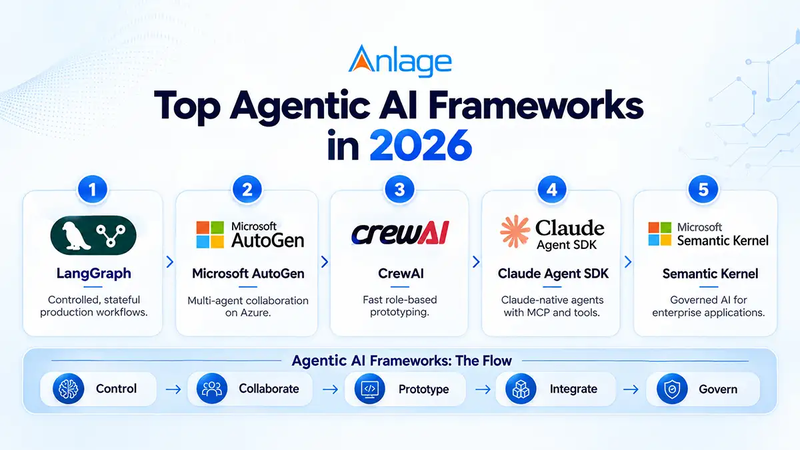
LangGraph
LangGraph is the production-grade agent orchestration framework from the LangChain team, and the default recommendation for most new enterprise deployments in 2026. It models agent workflows as directed graphs — agents and tools are nodes, state flows through edges, and conditional logic determines routing. This explicit architecture gives development teams fine-grained control over branching, retries, state persistence, and human-in-the-loop interruption points.
LangGraph reached v1.0 in October 2025 with durable execution and built-in persistence. Q2 2026 additions include per-node timeouts, node-level error handlers with Saga/compensation routing, and a DeltaChannel type that reduces checkpoint overhead for long-running workflows. In independent benchmarks across 2,000 task instances, LangGraph was fastest on latency across all five tested task types. For enterprises that need production control, auditability, and the ability to interrupt or modify agent state mid-workflow, LangGraph is the strongest choice.
Best for: Stateful, controllable production workflows with branching logic and human-in-the-loop requirements.
Microsoft AutoGen
AutoGen is Microsoft Research's multi-agent conversation framework — designed for scenarios where multiple AI agents need to collaborate, debate, and reach conclusions through structured dialogue. Its native integration with Azure OpenAI and the Microsoft 365 ecosystem makes it the default choice for enterprises deeply invested in the Microsoft stack.
AutoGen benefits from Microsoft Research's velocity: features from research papers land in AutoGen before most other frameworks. AutoGen 1.0 shipped in 2026 with significant improvements to multi-agent coordination and observability. For enterprises building agents that need to coordinate across Azure services, AutoGen offers the tightest integration with the least custom middleware.
Best for: Multi-agent conversation workflows in Microsoft Azure environments.
CrewAI
CrewAI uses a role-based abstraction model — agents are defined as crew members with specific roles, goals, and backstories, and tasks are assigned to crew members who collaborate to complete them. This makes it the fastest framework for prototyping multi-agent systems, particularly for non-technical stakeholders who can reason intuitively about role-based task assignment.
The trade-offs are real. CrewAI carries up to 3× the token footprint of LangGraph on simple single-tool-call workflows, per independent benchmarks. Its role-based abstraction becomes a liability when workflows need fine-grained conditional branching or explicit state management. Most enterprise teams that start with CrewAI for prototyping migrate to LangGraph when moving to production. CrewAI 0.105 added enterprise observability in early 2026, improving the governance story.
Best for: Fast prototyping of multi-agent systems; role-based task automation where speed-to-demo matters.
Anthropic Claude Agent SDK
Anthropic's Claude Agent SDK — renamed from Claude Code SDK in early 2026 to reflect broader agent scope — provides production-grade primitives for tool use, MCP integration, and hierarchical agent spawning. Parent agents can create child agents up to three levels deep, enabling layered task decomposition for complex enterprise workflows. It added fallback model chains, per-agent cost attribution, and scoped permissions in 2026, addressing the cost governance gap that affects most agentic deployments.
Best for: Enterprises building Claude-native agents requiring deep tool integration, hierarchical orchestration, and production-grade cost governance.
Semantic Kernel
Semantic Kernel is Microsoft's enterprise SDK for integrating AI into existing application code — emphasizing software engineering discipline, type safety, and structured integration patterns. It is less flexible than LangGraph but more predictable, which matters in regulated industries where agent behavior needs to be auditable and consistent.
Best for: Regulated enterprise environments where governance, auditability, and integration with existing .NET or Python codebases are the primary constraints.
How to Choose an Agentic AI Framework: The Enterprise Decision Framework
Framework selection should be driven by four questions, not by developer familiarity or benchmark scores.
- What is the workflow complexity? Single-agent, single-task workflows with predictable inputs can run on any framework. Multi-agent, multi-step workflows with conditional branching, state persistence, and human-in-the-loop requirements need LangGraph or AutoGen. Role-based multi-agent collaboration for prototyping needs CrewAI.
- What is the governance requirement? In regulated industries — BFSI, healthcare, defence — agents must be auditable, interruptible, and explainable. LangGraph's explicit graph architecture and Semantic Kernel's engineering discipline address this. Frameworks that abstract away execution logic make governance significantly harder to implement.
- What is the infrastructure environment? Azure-native enterprises should default to AutoGen or Semantic Kernel. Claude-native deployments should evaluate the Anthropic Agent SDK. Enterprises with multi-cloud or cloud-agnostic requirements should favour LangGraph, which has the broadest infrastructure compatibility.
- What is the production timeline? If production is 12+ months out and the primary goal is rapid prototyping, CrewAI accelerates learning. If production is the immediate goal, start with LangGraph or the relevant vendor SDK and avoid the migration cost of moving from CrewAI to a production-grade framework under deadline pressure.
The Governance Imperative: Why 40% of Agentic AI Projects Fail
The single most consistent pattern in failed agentic AI deployments is governance treated as a post-deployment problem. Gartner's projection that 40% of agentic AI projects will be cancelled by 2027 is not a technology failure — it is a governance failure. Only 21% of organizations have a mature governance model for autonomous AI agents, according to enterprise survey data.
For enterprise leaders, the governance requirements that must be addressed at framework selection stage — not after deployment — are:
- Auditability — every agent action must be logged with sufficient context to reconstruct what decision was made, why, and on what data
- Interruptibility — human-in-the-loop mechanisms must be designed into the workflow architecture, not bolted on after agents are running
- Cost attribution — agentic workflows can consume significantly more tokens than single-model interactions; per-agent cost tracking is a prerequisite for production economics
- Data access scoping — agents must operate on the minimum data access required for their task; broad access grants create compliance exposure that most organizations do not identify until after a breach
For context on how agentic AI fits within a broader enterprise AI operating model, our analysis of the role of technology in Global Capability Centers and what physical AI means for enterprise operations covers adjacent capability areas in depth.
The Bottom Line
Agentic AI frameworks are the infrastructure layer that determines whether an enterprise's AI agents can operate reliably in production, be governed without constant manual oversight, and scale beyond the initial pilot. The framework decision is not a developer choice — it is an architectural decision with 2–3 year implications for how AI capability is built and governed across the enterprise.
The enterprises that will extract durable value from agentic AI are those that select frameworks based on production requirements, governance constraints, and infrastructure environment — not on prototype performance or developer familiarity. The 40% cancellation rate Gartner projects is not inevitable. It is the outcome of treating agentic AI frameworks as a technical detail rather than a strategic architecture decision.
How Anlage Digital Helps Enterprises Build and Govern Agentic AI
Anlage Digital's AI services practice and AI operations capability are built around the full agentic AI lifecycle — from framework selection and agent architecture design through to production deployment, governance implementation, and managed operations.
- Agentic AI framework assessment — evaluating LangGraph, AutoGen, CrewAI, and vendor SDKs against your specific use case, governance requirements, and infrastructure environment
- Agent architecture design — designing multi-agent orchestration patterns, state management, tool integration, and human-in-the-loop workflows for production deployment
- Governance framework implementation — building audit trails, cost attribution, data access scoping, and interruptibility mechanisms from the ground up
- Production deployment and integration — connecting agentic AI frameworks to enterprise data platforms, APIs, and application estates with full observability
- AI operations and monitoring — running agentic AI infrastructure in production with continuous performance monitoring, cost optimization, and model refresh management
- Agentic AI talent — sourcing AI engineers with framework-specific expertise through Select10x from a 30 million-strong talent database
With 28+ years of enterprise technology experience and delivery teams operating across BFSI, Retail, Healthcare, and Manufacturing, Anlage brings the architectural depth and governance discipline that production agentic AI deployment demands.
If your organization is evaluating agentic AI frameworks or moving from pilot to production, talk to an Anlage AI expert to map the right framework and governance architecture for your environment.
Frequently Asked Questions
1. What are agentic AI frameworks?
Agentic AI frameworks are orchestration libraries for building AI agents that plan, reason, and act autonomously across tools and systems. They sit between the foundation model and enterprise application layers, handling state, tool integration, and governance.
2. What is the difference between agentic AI and generative AI?
Generative AI responds to a single prompt and produces an output. Agentic AI maintains state, chains decisions across multiple steps, and executes tasks autonomously — using generative models as its reasoning engine with orchestration added on top.
3. Which agentic AI framework is best for enterprise production?
LangGraph is the strongest production default — offering state control, auditability, and human-in-the-loop capability. AutoGen suits Azure environments, the Claude Agent SDK suits Claude-native workflows, and CrewAI is best kept for prototyping.
4. Why do agentic AI projects fail?
Gartner projects 40%+ of agentic AI projects will be cancelled by 2027 — driven by weak governance, unclear ROI, and runaway costs. Only 21% of organizations have mature governance models, meaning most deployments lack the controls production requires.
5. How should enterprises govern agentic AI deployments?
Governance must be designed into the framework architecture from day one, not added after. Enterprises need audit logs, human-in-the-loop interruption points, per-agent cost attribution, and minimum-necessary data access scoping built in from the start.
Build Your Innovation GCC in India
Anlage has set up 350+ GCCs across Retail, BFSI, Healthcare, and Technology. We can have your first team operational in 60 days.
Start the Conversation