
An Employer of Record (EOR) is a third-party organization that becomes the legal employer of your workforce in a foreign country — handling payroll, tax compliance, employment contracts, benefits administration, and local labor law obligations — while your team continues to work under your direction. It is the fastest way for global enterprises to hire in a new market without setting up a local legal entity.
The EOR model has grown from a niche compliance tool to mainstream enterprise infrastructure. According to Data Bridge Market Research, the global EOR market was valued at $5.73 billion in 2025 and is projected to reach $9.80 billion by 2033, growing at 7.7% CAGR. Slasify's 2026 EOR statistics report that 86% of HR leaders cite international compliance as their top hiring challenge — precisely the problem EOR solves.
But EOR is not a permanent solution. It is a bridge — fast, flexible, and effective for market entry and team validation. At a certain scale and strategic maturity, the Employer of Record model becomes a ceiling, not an accelerator. That is when enterprises need to evaluate the move to a Global Capability Center.
What is an Employer of Record (EOR)?
An Employer of Record is a third-party company that legally employs workers on behalf of another business in a foreign jurisdiction, handling all employment compliance, payroll processing, tax filing, and benefits administration while the client company retains full day-to-day management control over the employees' work.
The EOR model exists because international hiring is legally complex. Hiring even one employee in a foreign country typically requires establishing a local legal entity — a process that takes 6–12 months and costs $50,000–$250,000 per country. An EOR eliminates that barrier entirely, allowing enterprises to hire compliantly in new markets within weeks. The EOR provider is the employer of record on paper; the client company manages the people.
EOR vs GCC: How They Differ
Dimension | Employer of Record (EOR) | Global Capability Center (GCC) |
|---|---|---|
Legal employer | Third-party EOR provider | Parent enterprise directly |
Setup time | 1–4 weeks | 60 days (GCC-as-a-Service) to 12 months |
Setup cost | $199–$599 per employee/month | $2–5M for full build |
Team size sweet spot | 1–40 people | 40+ people |
IP ownership | Client retains (contractual) | Parent enterprise fully retains |
Data security | Shared with EOR infrastructure | Fully in-house |
Talent ownership | EOR manages employment | Direct employment relationship |
Institutional knowledge | Limited — EOR manages HR | Accumulates over time |
Cultural integration | Low — no entity, no office | High — captive team, your culture |
Long-term cost efficiency | Higher per-head at scale | Lower per-head at scale |
Regulatory compliance | EOR handles completely | Enterprise owns with local support |
Strategic fit | Market entry, validation, small teams | Long-term capability, IP-sensitive work |
When Does EOR Make Sense?
EOR is the right model for enterprises that need to move fast, operate lean, and test a new market before committing to a permanent entity. It removes the compliance barrier to global hiring — which is why 35% of U.S. cross-border hires in 2024 were made via EOR, according to Select Software Reviews.
EOR is the right choice when:
- You need to hire in a new country in weeks, not months — a product launch deadline, a regulatory requirement, or a talent opportunity that cannot wait for entity formation
- Your team in the target market is fewer than 30–40 people and does not justify the cost and complexity of a captive entity
- The work is operational rather than strategically sensitive — you are not creating proprietary IP or running mission-critical systems through the EOR structure
- You are entering a new geography for the first time and want to validate the talent market, cost structure, and operating model before committing to a permanent presence
- Your finance and legal teams do not have the bandwidth to manage entity formation, local tax registration, and employment law compliance in parallel with core business priorities
EOR works particularly well as the entry model for enterprises that eventually plan to build a GCC. Many of Anlage's GCC clients began with an EOR arrangement — using it to hire founding team members, test the India talent market, and establish operational rhythm before converting to a captive structure. For more on that journey, our guide on setting up a captive unit in India covers the entity setup process in full.
The Limitations of EOR at Scale
The EOR model has a ceiling — and enterprises that do not recognize it early enough pay a significant cost when they hit it.
Talent ownership and retention. EOR employees are employed by the EOR provider, not by the enterprise. This creates a structural distance that affects culture, career development, and retention. At small team sizes this is manageable. At 50+ people running mission-critical operations, the absence of a direct employment relationship is a material risk. Turnover in EOR arrangements is structurally higher because the employee has no direct career path within the enterprise.
IP and data security. When operations run through an EOR's infrastructure, enterprise data moves through third-party systems. For most operational functions this is acceptable. For AI development, proprietary product engineering, data platform work, or regulated BFSI and healthcare functions, it is not. The GCC model eliminates this risk entirely by keeping all systems, data, and IP within the parent enterprise's own infrastructure.
Cost economics. EOR pricing of $199–$599 per employee per month is efficient for small teams. At 50 employees, that is $120,000–$360,000 annually — purely in EOR fees, before salary. At 100 employees, the EOR cost alone justifies the setup cost of a captive entity within 18–24 months. The breakeven calculation is the most common trigger for the EOR-to-GCC conversation.
Strategic ceiling. EOR is designed for compliance, not for capability building. An enterprise running a 100-person engineering team through an EOR cannot operate with the same strategic depth, cultural integration, or talent development infrastructure as an enterprise with a captive GCC. The best talent — senior engineers, AI specialists, data architects — gravitates toward direct employment with a product company, not EOR arrangements where their career progression is constrained by the intermediary structure.
The EOR-to-GCC Migration: How Enterprises Make the Transition
The transition from EOR to GCC is a well-established path — and when executed correctly, it is one of the highest-ROI moves a global enterprise can make.
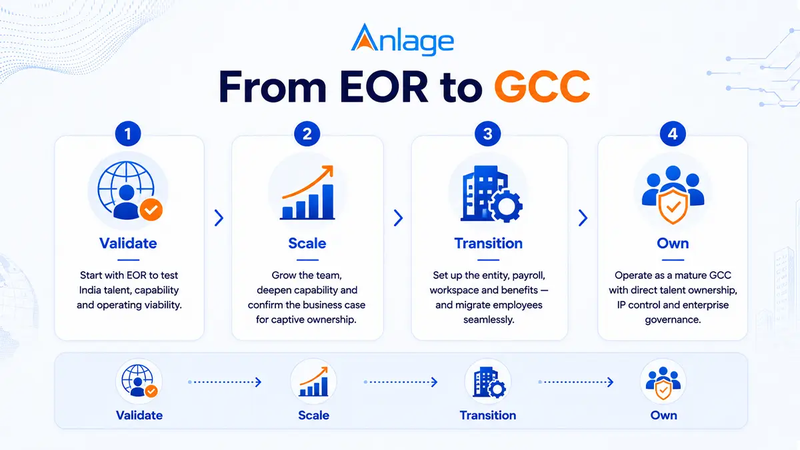
Stage 1 — EOR validation (months 0–12): The enterprise hires its first 10–20 people in India via EOR, validates the talent market, builds initial processes, and proves the offshore function delivers value. Cost is low, risk is minimal, and the exit is clean if the experiment does not work.
Stage 2 — Conversion decision (months 12–18): As the team grows toward 30–40 people and the offshore function becomes strategically significant, the enterprise evaluates conversion to a captive GCC. The trigger is typically one of four things: team size crossing the 40-person threshold, the work becoming IP-sensitive, the cost economics flipping in favor of a captive, or a talent retention problem driven by the EOR structure.
Stage 3 — GCC setup and transition (months 18–24): Entity formation, workspace, payroll infrastructure, and benefit structures are established. EOR employees are transitioned to direct enterprise employment. This requires careful management — contracts, notice periods, benefit continuity, and cultural onboarding all need to happen in parallel. For guidance on how to choose the right GCC location and the benefits that come with captive ownership, our analysis of GCC benefits for global enterprises covers both in detail.
Stage 4 — GCC maturity (month 24+): The captive GCC operates with full enterprise governance, direct employment, and the institutional depth that the EOR model cannot build. At this stage the enterprise owns its offshore capability — the talent, the IP, the culture, and the long-term competitive advantage it represents.
What Enterprises Get Wrong in the EOR-to-GCC Transition
The most common mistakes are all about timing.
Staying on EOR too long. The longer an enterprise runs a large team through an EOR, the higher the cultural distance, the greater the talent retention risk, and the more expensive the eventual conversion. The optimal transition window is 30–50 people — large enough to justify the setup cost, small enough that the conversion is manageable without disrupting delivery.
Underestimating the transition complexity. Converting 40 EOR employees to direct employment is not a straightforward HR exercise. Employment contracts, compensation structures, benefit plans, and notice period obligations all need to be resolved across individual employee situations. Most enterprises underestimate this by 3–4 months and face delivery disruption as a result.
Choosing the wrong GCC structure. The captive build is not the only option. A GCC-as-a-Service or Build-Operate-Transfer (BOT) arrangement allows enterprises to convert from EOR to a managed captive — where a partner like Anlage handles entity setup, workspace, compliance, and HR infrastructure — without requiring the internal bandwidth to build a GCC from scratch. This is the fastest path from EOR to captive ownership for enterprises without prior India entity experience.
The Bottom Line
An Employer of Record is the right starting point for enterprises entering a new market quickly, validating a talent pool, or hiring a small compliant team without the overhead of entity formation. It is fast, lean, and effective at what it is designed to do. It is not a permanent operating model for a strategically significant offshore function.
The enterprises building the most durable competitive advantage from offshore talent are those that use EOR as a bridge, convert to a captive GCC at the right threshold, and execute the transition with precision rather than defaulting to EOR indefinitely because it feels like the path of least resistance.
How Anlage Digital Helps Enterprises Move From EOR to GCC
Anlage Digital's GCC services are specifically designed for enterprises at every point in this journey — from the first EOR hire through to a fully operational captive GCC.
- EOR-to-GCC conversion planning — evaluating the right timing, structure, and transition approach based on team size, mandate, industry, and timeline
- GCC-as-a-Service — standing up a captive GCC in under 60 days, covering entity formation, workspace, compliance, payroll, and talent acquisition under one roof
- EOR transition management — handling the employment contract conversion, benefit continuity, and cultural onboarding required to move a team from EOR to direct employment without disrupting delivery
- AI-powered talent acquisition via Select10x — finding best-fit candidates for the expanded captive team from a 30 million-strong talent database
- Ongoing GCC operations — running the GCC infrastructure after launch with continuous performance management, compliance monitoring, and talent development
With 28+ years of enterprise experience and 350+ GCCs delivered across BFSI, Retail, Healthcare, and Technology, Anlage has managed the EOR-to-GCC transition across dozens of enterprises — and knows exactly where the complexity hides.
If your organization is evaluating whether to stay on EOR or make the move to a captive GCC, talk to an Anlage expert — we will help you build the case and execute the transition without disrupting delivery.
Frequently Asked Questions
1. What is an Employer of Record (EOR)?
An EOR is a third-party company that legally employs workers on your behalf in a foreign country — handling payroll, tax compliance, employment contracts, and benefits. You retain full day-to-day management control while the EOR handles all legal employer obligations.
2. What is the difference between an EOR and a GCC?
An EOR is a third-party provider that employs your team on your behalf; a GCC is a captive entity your enterprise owns directly, with employees on your own payroll. The core difference is ownership — of the employment relationship, the IP, and the institutional knowledge.
3. When should an enterprise switch from EOR to a GCC?
The switch typically makes sense when the offshore team crosses 30–40 people, the mandate becomes long-term and IP-sensitive, or the EOR cost economics flip in favor of a captive. Most enterprises hit this threshold between 12 and 24 months into their offshore journey.
4. Is EOR cheaper than setting up a GCC?
EOR has lower upfront cost — no entity setup, no infrastructure investment. A GCC has higher setup cost but lower per-head cost at scale; at 50+ employees the EOR fee alone typically justifies a captive within 18–24 months.
5. Can an enterprise use EOR and a GCC at the same time?
Yes — and many do. EOR covers fast-entry markets or small satellite teams while the GCC runs the core strategic function. The two models complement each other when scoped deliberately.
Build Your Innovation GCC in India
Anlage has set up 350+ GCCs across Retail, BFSI, Healthcare, and Technology. We can have your first team operational in 60 days.
Start the Conversation