
GCC-as-a-Service is a managed delivery model where a specialized partner sets up, operationalizes, and runs a Global Capability Center on behalf of an enterprise — handling entity formation, workspace, compliance, payroll, and talent acquisition — while the enterprise retains full ownership and strategic control from day one. It combines the speed and simplicity of outsourcing with the long-term ownership and IP security of a captive GCC.
According to the NASSCOM-Zinnov GCC Value Orbit 2026 report, India now hosts 2,117 GCCs generating $98.4 billion in revenue and employing 2.36 million professionals — a 32% growth since FY2021. Yet the most significant shift is not in scale. It is in who is building GCCs. Mid-market enterprises — those with revenues between $100 million and $1 billion — are now the fastest-growing GCC segment, and GCC-as-a-Service is the model making that growth possible for organizations that cannot absorb the complexity of a full captive build.
What is GCC-as-a-Service?
GCC-as-a-Service (also called GCC-aaS or the managed GCC model) is a turnkey delivery arrangement where an experienced GCC partner manages the entire setup and early operations of a Global Capability Center on behalf of the enterprise client — covering legal entity formation, regulatory compliance, real estate and workspace, payroll infrastructure, HR operations, and talent acquisition — while the enterprise retains ownership of the GCC, its employees, and its intellectual property throughout.
The model is distinct from outsourcing. In outsourcing, a vendor employs the workforce and manages the operations permanently on behalf of the client. In GCC-as-a-Service, the partner's involvement is structural and transitional — they build the infrastructure, stand up the team, and establish operating rhythms, then step back as the enterprise takes direct control. The enterprise owns the entity, employs the people, and accumulates the institutional knowledge. The partner removes the complexity of getting there.
GCC-as-a-Service vs Traditional GCC Build vs Outsourcing
Dimension | Outsourcing | GCC-as-a-Service | Traditional GCC Build |
|---|---|---|---|
Ownership | Vendor | Enterprise (from day one) | Enterprise |
Employees | Vendor's workforce | Enterprise's direct employees | Enterprise's direct employees |
Setup time | 2–4 weeks | 45–60 days | 6–12 months |
Setup complexity | Low — vendor manages all | Low — partner manages all | High — enterprise manages all |
Internal bandwidth required | Minimal | Low | Very high |
IP ownership | Vendor (contractual) | Enterprise fully | Enterprise fully |
Partner involvement | Permanent | Transitional — exits post-setup | None |
Cost efficiency at scale | Lower — vendor margin always present | High — captive economics after setup | High — but delayed by setup timeline |
First-mover speed | Fast | Fast | Slow |
Strategic control | Limited | Full | Full |
Why GCC-as-a-Service Has Become the Preferred Entry Model
The traditional GCC build requires enterprises to simultaneously navigate Indian company law, FEMA regulations, GST registration, real estate negotiation, payroll infrastructure, and talent acquisition — typically a 6–12 month process that demands significant internal legal, finance, and HR bandwidth that most mid-market enterprises do not have available.
GCC-as-a-Service solves this through specialization. A partner that has executed dozens of GCC setups has already solved the legal, regulatory, and operational complexity. What takes a first-time entrant 9 months takes an experienced GCC-as-a-Service partner 45–60 days — because the infrastructure, relationships, and process playbooks already exist.
According to Zinnov's 2025 GCC landscape analysis, mid-market GCCs in India are 1.3x more likely to operate as transformation hubs and 1.2x faster in traversing the maturity curve than large-enterprise GCCs of equivalent age. The speed advantage comes from the GCC-as-a-Service model — they are not building from scratch, they are inheriting operational infrastructure that lets them focus on capability from week one.
For enterprises evaluating why GCCs are making a comeback as the preferred offshore model, our analysis of why global in-house centres are growing again covers the structural drivers in depth.
What GCC-as-a-Service Covers: The Full Scope
A well-structured GCC-as-a-Service engagement covers every layer of the GCC setup and early operations:
Legal and Entity Formation Company registration under Indian law, FEMA compliance for foreign-owned entities, GST registration, Permanent Establishment (PE) risk structuring, and all regulatory filings required before the first employee joins. This is typically the longest and most complex element of a traditional GCC build — a GCC-as-a-Service partner compresses it significantly through established legal infrastructure and regulatory relationships.
Workspace and Infrastructure Office identification, lease negotiation, fit-out, IT infrastructure deployment, and facilities management. A GCC-as-a-Service partner operating in India's major GCC cities — Bengaluru, Hyderabad, Pune, Chennai — has established real estate relationships that give enterprise clients access to the right locations faster and at better terms than a first-time entrant negotiating independently.
Payroll, HR, and Compliance Payroll processing, statutory compliance (PF, ESI, PT, TDS), offer letter and employment contract templates aligned with local labor law, employee benefits structuring, and ongoing HR operations. For most mid-market enterprises, building this infrastructure from scratch in a new jurisdiction is the single largest operational risk in a GCC setup.
Talent Acquisition End-to-end hiring for the founding GCC team — sourcing, screening, skills assessment, and onboarding. The founding team hire is the most consequential element of any GCC setup; the quality of the first 20 hires determines the center's culture, delivery quality, and ability to attract subsequent talent. GCC-as-a-Service partners with established talent networks and AI-powered hiring platforms can compress time-to-hire significantly versus a first-time entrant building relationships in an unfamiliar talent market.
Governance and Operating Model Design KPI frameworks, reporting structures, governance rhythms, and the operating model that connects the GCC to the enterprise's global leadership. This is where the transition from managed to captive begins — establishing the governance architecture that allows the enterprise to take full control as the GCC matures.
The Build-Operate-Transfer (BOT) Structure Within GCC-as-a-Service
GCC-as-a-Service is often implemented through a Build-Operate-Transfer (BOT) arrangement — a three-phase structure that defines exactly how and when the partner transitions responsibility to the enterprise.
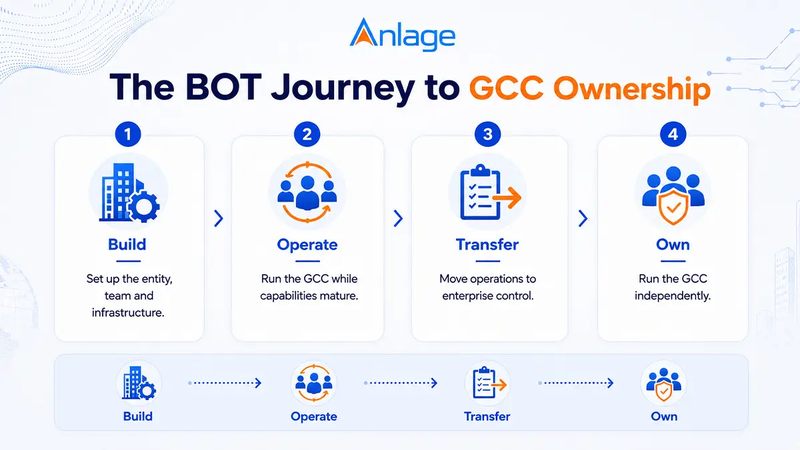
Build phase (months 1–3): The partner establishes the legal entity, workspace, and HR infrastructure. The founding team is hired. The GCC begins operations with the partner managing all administrative and operational overhead.
Operate phase (months 3–18): The GCC runs under the partner's operational management while the enterprise focuses on building delivery capability and cultural integration. The partner handles compliance, payroll, HR operations, and facilities — the enterprise directs the work and builds the strategic function.
Transfer phase (months 12–24): The GCC transitions to full enterprise ownership and management. The partner hands over operational responsibility systematically — legal entity control, HR processes, facilities management, and vendor relationships — according to a defined transfer plan. The enterprise emerges with a fully operational captive GCC and the institutional knowledge to run it independently.
The BOT structure is what makes GCC-as-a-Service categorically different from outsourcing. The endpoint is always full captive ownership — the partner's involvement is explicitly time-bound and structured around the enterprise's readiness to assume control.
Who GCC-as-a-Service Is Built For
Not every enterprise needs GCC-as-a-Service. Large multinationals with existing India entities and established legal and HR infrastructure in-country can typically run a traditional captive build. GCC-as-a-Service addresses a specific profile of enterprise:
Mid-market enterprises (revenue $100M–$1B) entering India for the first time, where the complexity of entity formation and regulatory compliance is disproportionate to internal bandwidth. The NASSCOM 5-Year GCC Journey report identifies mid-market enterprises as the fastest-growing segment of India's GCC ecosystem — and GCC-as-a-Service is the primary delivery model enabling that growth.
Enterprises with urgent timelines — product launches, regulatory requirements, or competitive pressures that make the 9–12 month traditional build timeline unacceptable. GCC-as-a-Service compresses setup to 45–60 days.
First-time India entrants without established local legal, regulatory, or real estate relationships, where the learning curve of navigating India's business environment would consume senior leadership bandwidth for months.
Enterprises converting from EOR or outsourcing who want to move to captive ownership without rebuilding operational infrastructure from zero.
For context on what defines a successful GCC location and the city-level factors that affect GCC setup decisions, our guide to GCC location factors covers the decision framework in detail. And for enterprises evaluating the most common setup challenges, our analysis of the 5 biggest GCC setup challenges and how hubs address them is directly relevant.
What to Look for in a GCC-as-a-Service Partner
The GCC-as-a-Service market is not homogeneous. The quality of setup execution varies significantly between providers, and the wrong partner choice at this stage creates operational and cultural problems that outlast the setup phase.
Track record at scale. How many GCCs has the partner set up end-to-end? Partners with 50+ setups have solved problems that partners with 5–10 have never encountered. Ask for references from enterprises at similar scale and industry.
Talent infrastructure. The founding team hire is the most critical deliverable in any GCC setup. Does the partner have an established talent network in the relevant skills and locations, or will they be recruiting from scratch alongside you? AI-powered candidate matching — versus traditional job board sourcing — materially reduces time-to-hire and first-year attrition.
Legal and compliance depth. FEMA compliance for foreign-owned entities, PE risk structuring, and GST registration require specialists. A GCC-as-a-Service partner without in-house legal expertise on these specific areas will outsource them to third parties — adding time, cost, and coordination overhead.
Transfer quality, not just setup speed. The measure of a GCC-as-a-Service engagement is not how fast the entity is set up. It is whether the enterprise can operate the GCC independently after the transfer. Ask specifically: what does the transfer plan look like, and what operational capability will we have at the end of it?
The Bottom Line
GCC-as-a-Service is the model that has made captive GCC ownership accessible to mid-market enterprises that previously could not absorb the complexity of a traditional build. It delivers the ownership, IP security, and long-term strategic value of a captive GCC — with the speed, simplicity, and risk management of a managed setup.
The growth of India's GCC ecosystem to 2,117 centers and $98.4 billion in revenue is not driven by large multinationals alone. It is increasingly driven by mid-market enterprises that recognized the competitive advantage of captive ownership and found a faster, more manageable path to it through GCC-as-a-Service. The question for enterprise leaders is not whether to own their India capability — it is how quickly they can get there.
How Anlage Digital's GCC-as-a-Service Works
Anlage Digital's GCC-as-a-Service model is built on 28+ years of enterprise experience and 350+ GCC setups across BFSI, Retail, Healthcare, and Technology. We manage the full setup lifecycle — so enterprises are operational in under 60 days without consuming internal bandwidth on regulatory, legal, and HR complexity.
- Legal entity formation — company registration, FEMA compliance, GST, PE risk structuring, all managed in-house with no third-party legal hand-offs
- Workspace — office identification, lease negotiation, fit-out, and IT infrastructure across Bengaluru, Hyderabad, Pune, Chennai, and Mumbai
- Payroll and compliance — full statutory compliance from day one: PF, ESI, PT, TDS, employment contracts aligned with local labor law
- Talent acquisition via Select10x — AI-powered hiring from a 30 million-strong talent database, identifying best-fit candidates for the founding GCC team
- Governance design — KPI frameworks, reporting structures, and operating model architecture that connects the GCC to enterprise leadership from the start
- BOT transfer plan — a defined, structured handover that gives the enterprise full operational control at the pace their readiness allows
If your organization is evaluating a GCC setup in India and wants to understand what the 60-day path to a captive GCC looks like, talk to an Anlage expert — we'll map the setup timeline, cost structure, and governance model for your specific mandate.
Frequently Asked Questions
1. What is GCC-as-a-Service?
GCC-as-a-Service is a managed model where a specialist partner sets up a Global Capability Center — handling entity formation, workspace, compliance, payroll, and talent — while the enterprise retains full ownership and IP from day one. It is not outsourcing; the partner's involvement is transitional, not permanent.
2. How long does GCC-as-a-Service take to set up?
An experienced GCC-as-a-Service partner can get the first team operational in 45–60 days — compared to 6–12 months for a traditional captive build. The speed comes from established legal infrastructure, regulatory relationships, and talent networks the partner already has in place.
3. How is GCC-as-a-Service different from outsourcing?
In outsourcing, the vendor employs your team permanently and manages operations on your behalf. In GCC-as-a-Service, the partner's involvement is time-bound — they build the infrastructure and then transfer full ownership and control to the enterprise. The enterprise owns the entity, employs the people, and retains all IP.
4. What does GCC-as-a-Service cost?
Costs vary by team size, location, and scope — but GCC-as-a-Service eliminates the largest single cost of a traditional build: the internal bandwidth required to manage entity formation, compliance, and talent acquisition simultaneously. Setup fees plus operational management are typically lower than the opportunity cost of doing it internally for most mid-market enterprises.
5. Who is GCC-as-a-Service best suited for?
Mid-market enterprises ($100M–$1B revenue) entering India for the first time, enterprises with urgent setup timelines, and organizations converting from EOR or outsourcing to captive ownership. It is also well-suited for enterprises without existing India legal or HR infrastructure.
Build Your Innovation GCC in India
Anlage has set up 350+ GCCs across Retail, BFSI, Healthcare, and Technology. We can have your first team operational in 60 days.
Start the Conversation