
Global enterprises have two fundamentally different ways to build technology teams outside their home market: IT staff augmentation, which adds external specialists to an existing team on a contract basis, or a Global Capability Center (GCC), which is a captive, wholly owned offshore unit staffed by the enterprise's own employees. Both deliver access to global talent. Both reduce cost compared to domestic hiring. But they are architecturally different — and choosing the wrong one at the wrong stage costs millions and years.
The global IT staff augmentation market is projected to reach $857.2 billion by 2032, growing at a CAGR of 13.2%, according to Verified Market Research. At the same time, India's GCCs are projected to reach $110 billion in revenue by 2030, up from $46 billion in 2023, according to NASSCOM — a divergence that reflects two parallel strategies enterprises are pursuing simultaneously. The question is not which model is better. It is which model is right for your organization, at your stage, for your mandate.
What Is IT Staff Augmentation?
IT staff augmentation is a flexible workforce model where enterprises supplement their internal technology teams with external specialists — software engineers, data scientists, cloud architects, AI engineers — sourced from a third-party provider on a contract basis. The augmented professionals work under the enterprise's direct supervision, use the enterprise's tools and systems, and are integrated into the enterprise's delivery workflows. They are employed by the vendor; they operate as part of the enterprise's team.
The model is designed for speed and flexibility. Augmented teams can be onboarded in two to four weeks, scaled up or down as project demands change, and disengaged at contract end without the complexity of employment termination. According to Verified Market Research, nearly 62% of enterprises adopt staff augmentation to manage dynamic workloads, while around 58% prioritize it for rapid access to specialized skills.
What IT staff augmentation does not deliver is ownership, institutional knowledge accumulation, or long-term IP security. The talent goes home to the vendor when the engagement ends — and the enterprise starts over.
What Is a Global Capability Center (GCC)?
A Global Capability Center is a captive offshore entity — wholly owned and operated by the parent enterprise — established to deliver strategic functions including technology engineering, data, AI, analytics, finance, and operations. The GCC's employees are on the parent's payroll. Its IP belongs to the parent. Its governance is set by the parent's leadership, not by vendor contracts or SLAs.
According to NASSCOM, India hosts over 1,800 GCCs employing 1.9 million professionals and generating $64 billion in annual revenue as of FY2024. The GCC model has moved decisively beyond cost arbitrage — the enterprises running the most mature GCCs are using them as strategic innovation hubs, owning product roadmaps, driving R&D, and contributing directly to global P&L outcomes.
The trade-off is setup complexity and time. A GCC requires entity formation, regulatory compliance, workspace, payroll infrastructure, and talent acquisition — typically a 6–12 month process for a first-time entrant, or under 60 days with a managed GCC-as-a-Service partner.
IT Staff Augmentation vs GCC: Direct Comparison
Dimension | IT Staff Augmentation | GCC (Captive) |
|---|---|---|
Ownership | Third-party vendor | Parent enterprise |
Employees | Vendor's workforce | Parent's direct employees |
IP ownership | Vendor (contractually transferred) | Parent enterprise — fully retained |
Setup time | 2–4 weeks | 6–12 months (or under 60 days via GCC-as-a-Service) |
Setup cost | Low — no entity, no infrastructure | $2–5M for full build; lower via BOT model |
Team size | Flexible — 1 to 100+ | Typically 40+ to justify setup cost |
Control | Contract-governed | Direct governance and culture |
Talent retention | Higher attrition — vendor manages team | Lower attrition — direct employment, career path |
Institutional knowledge | Lost at contract end | Accumulates over time |
Data security | Shared with vendor infrastructure | Fully in-house |
Long-term cost | Scales with headcount at vendor margin | Lower per-head cost at scale |
Strategic fit | Short-term projects, skill gaps, surge capacity | Long-term mandates, IP-sensitive work, innovation |
When to Choose IT Staff Augmentation
IT staff augmentation is the right model when the requirements are time-bound, the work is well-defined, and the enterprise does not need to own the talent or the institutional knowledge being generated.
Choose IT staff augmentation when:
- You need a capability onboarded in weeks, not months — a critical product launch, a regulatory deadline, a surge in development demand
- The team size requirement is under 30–40 people and does not justify the setup overhead of a captive entity
- The work is project-specific — a platform migration, a data warehouse build, a mobile application — rather than an ongoing operational mandate
- You are testing an offshore location or technology area before committing to a permanent presence
- Your internal bandwidth to manage entity formation, local HR, compliance, and payroll is limited
According to NASSCOM research, for projects lasting 3–12 months, staff augmentation provides the best flexibility. Beyond that window, the economics and strategic calculus shift materially toward a captive model.
When to Choose a GCC
A GCC is the right model when the mandate is ongoing, the work is strategically sensitive, and the enterprise needs to own the talent, the IP, and the institutional knowledge being built.
Choose a GCC when:
- Your offshore function will run mission-critical, data-sensitive, or innovation-led work where IP security is non-negotiable
- You are building for a 3+ year horizon with a team of 40 or more
- You operate in a regulated industry — BFSI, healthcare, defence — where data residency and compliance ownership require a captive structure
- You want offshore teams embedded in your culture, evaluated against your strategic KPIs, and accountable to your leadership — not to a vendor SLA
- You are scaling a function — data engineering, AI, product development — where institutional knowledge and talent depth compound over time and cannot be rebuilt from scratch with each contract renewal
Forrester's analysis of NASSCOM 2025 confirms the service model spectrum spans from build-operate-transfer for greenfield GCCs to traditional outsourcing arrangements for mature centers — reflecting that the GCC journey itself has multiple entry points, not just the full captive build.
For enterprises evaluating the full spectrum of GCC operating structures, our analysis of GCC operating model options covers the decision framework in detail.
The Migration Path: From Staff Augmentation to GCC
Many enterprises do not choose between these models — they use both, sequentially. The pattern is well-established: staff augmentation validates the offshore location and technology area, builds initial knowledge of the talent market, and delivers short-term capacity. Once the offshore function reaches strategic significance — 40+ people, ongoing mandate, IP-sensitive work — the enterprise converts to a captive GCC.
This migration path has three distinct stages:
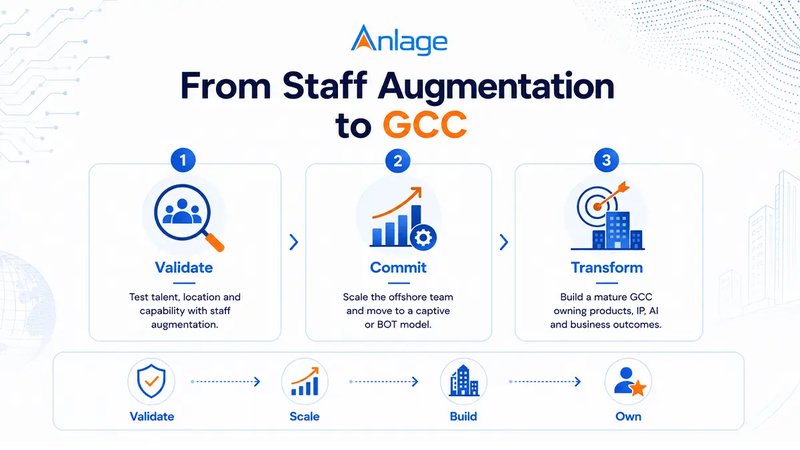
Stage 1 — Validation (0–12 months): Staff augmentation for a defined project or capability. The enterprise learns which skills are available, what the talent market looks like, and whether the offshore location delivers the expected outcomes. Low risk, fast to stand up, easy to exit.
Stage 2 — Commitment (12–24 months): As the offshore function proves its value, the enterprise begins transitioning to a captive model — either a direct build or a Build-Operate-Transfer (BOT) arrangement where a managed partner sets up and runs the GCC on the enterprise's behalf before transferring full ownership. For more on talent acquisition during this transition, our guide to talent acquisition strategies for fast-growing GCCs covers the hiring model in detail.
Stage 3 — Maturity (24+ months): The GCC operates as a strategic delivery hub — owning product roadmaps, driving AI and data initiatives, and operating with end-to-end accountability. For a step-by-step breakdown of the entity setup process, see our guide on setting up a captive unit in India.
The Hidden Costs Enterprises Miss
Both models carry costs that are not visible in the initial pricing conversation.
IT staff augmentation hidden costs:
- Internal management overhead — per NASSCOM benchmarks, budget an additional 15–20% above raw augmentation costs for internal management time
- Ramp cost at every contract renewal — every new augmented engineer needs onboarding, context, and time before they reach full productivity
- Knowledge loss at disengagement — institutional knowledge built during the engagement leaves with the augmented team
- Vendor margin compression — over multi-year engagements, augmentation rates escalate while switching costs grow
GCC hidden costs:
- Setup complexity for first-time entrants — entity formation, regulatory compliance, workspace sourcing, and payroll infrastructure require local expertise that most enterprises do not have in-house
- Time to operational maturity — a GCC that launches in 60 days still needs 12–18 months to reach the delivery quality and cultural integration of a mature team
- Leadership investment — the highest-performing GCCs appoint India-based leaders with real P&L accountability, which requires deliberate investment in local talent development
The Bottom Line
IT staff augmentation and GCCs are not competing models — they are different tools for different stages of an enterprise's global operating strategy. Staff augmentation is the right entry point: fast, flexible, low-commitment, ideal for proving the concept and filling immediate gaps. The GCC is the right destination: owned, governed, strategically embedded, and compounding in value over time.
The enterprises generating the most sustained competitive advantage from offshore operations are those that use staff augmentation deliberately as a bridge, not a permanent solution — and that make the transition to captive ownership before the window closes on building institutional depth.
How Anlage Digital Helps Enterprises Navigate This Decision
Anlage Digital's GCC services are designed specifically for enterprises at every stage of this journey — from initial offshore validation through to full captive GCC ownership.
- Strategic advisory — helping enterprise leaders evaluate staff augmentation vs GCC vs BOT model based on mandate, team size, industry, and timeline
- GCC-as-a-Service — standing up a captive GCC in under 60 days, covering entity formation, workspace, compliance, payroll, and talent acquisition under one roof
- AI-powered talent acquisition via Select10x — sourcing engineers, data scientists, and AI specialists from a 30 million-strong talent database, finding best-fit candidates not first-available ones
- Managed transition support — handling the migration from augmented vendor teams to captive GCC employment, including knowledge transfer and continuity planning
- Ongoing GCC operations — running the GCC infrastructure after launch with continuous performance management and talent development
With 28+ years of enterprise experience and 350+ GCCs delivered across BFSI, Retail, Healthcare, and Technology, Anlage has managed both sides of this transition — and knows exactly where enterprises lose time and money in the move from augmentation to captive ownership.
If your organization is evaluating whether to stay with staff augmentation or make the move to a GCC, talk to an Anlage expert — we will help you map the right model for your specific mandate and timeline.
Frequently Asked Questions
1. What is IT staff augmentation?
IT staff augmentation is a model where enterprises add external technology specialists to their internal teams on a contract basis through a third-party vendor. The augmented professionals work under the enterprise's direction but remain employed by the vendor.
2. What is the difference between IT staff augmentation and a GCC?
Staff augmentation adds vendor-employed contractors to your team; a GCC is a captive entity wholly owned by your enterprise, staffed by your own employees. The core difference is ownership — of the talent, the IP, and the institutional knowledge being built.
3. Which is cheaper — IT staff augmentation or a GCC?
Staff augmentation has lower upfront cost but scales at vendor margin; a GCC has higher setup cost but significantly lower per-head cost at scale — typically breaking even at 40+ people over 2–3 years.
4. When should an enterprise move from staff augmentation to a GCC?
The transition makes sense when the offshore function has grown beyond 30–40 people, the mandate is ongoing, and the work involves IP-sensitive or mission-critical functions. Most enterprises make this move between 12 and 24 months into their offshore journey.
5. Can an enterprise use both IT staff augmentation and a GCC at the same time?
Yes — and many do. Staff augmentation fills immediate skill gaps and surge capacity while the GCC handles the core, long-term strategic mandate.
Build Your Innovation GCC in India
Anlage has set up 350+ GCCs across Retail, BFSI, Healthcare, and Technology. We can have your first team operational in 60 days.
Start the Conversation