
Insourcing is the practice of bringing business functions in-house — staffing them with the enterprise's own employees, under its direct governance and within its own operational infrastructure. Outsourcing is the practice of contracting those functions to a third-party provider. For decades, these two models were treated as an either/or decision. The data from 2026 tells a fundamentally different story.
According to Deloitte 2024 survey, 80% of executives plan to maintain or increase third-party outsourcing spend — while simultaneously, insourcing and Global In-house Centers (GICs) are surging as organizations rebalance their talent ecosystems. The emerging model is not insourcing vs outsourcing. It is multidimensional sourcing: a deliberate portfolio of captive capability, outsourced delivery, and AI-augmented operations, each assigned to the work it is best suited for.
Understanding when to insource, when to outsource, and how to manage the boundary between them is now one of the most consequential operating decisions a global enterprise makes.
What is Insourcing?
Insourcing is a talent and operations strategy where an enterprise builds and maintains internal capability — hiring its own employees, managing its own processes, and retaining direct governance and IP ownership over the functions it runs. It is the opposite of outsourcing: the work is done inside the enterprise rather than delegated to a vendor.
In the context of global enterprises, insourcing increasingly takes the form of Global In-house Centers (GICs) or Global Capability Centers (GCCs) — captive offshore entities that deliver the cost and talent advantages of offshore operations while retaining the ownership, culture, and IP security of an internal function. According to Deloitte insourcing report, well-run GICs give companies the cultural alignment and IP security of insourcing while preserving the labour-arbitrage benefits of offshore locations.
What is Outsourcing?
Outsourcing is a delivery model where an enterprise contracts a third-party provider to perform specific business functions — technology development, business process operations, customer service, finance and accounting, HR — under a service agreement. The provider employs the workforce, manages operations, and is accountable to the enterprise through SLAs and contract terms.
The global outsourcing market was valued at approximately $1.09 trillion in 2025, according to Prialto 2026 data. IT services account for the largest share of total outsourcing contract value globally, with 80% of executives in 2024 reporting plans to maintain or increase outsourcing investment. Outsourcing's appeal has always been speed, flexibility, and the ability to access specialized capability without building it from scratch.
Insourcing vs Outsourcing: Direct Comparison
Dimension | Insourcing (GCC / Captive) | Outsourcing (Third-Party) |
|---|---|---|
Workforce ownership | Enterprise's direct employees | Vendor's employees |
IP ownership | Enterprise — fully retained | Vendor (contractually transferred) |
Governance | Direct enterprise control | Contract and SLA-governed |
Setup time | 60 days (GCC-as-a-Service) to 12 months | 2–4 weeks |
Setup cost | Higher — entity, workspace, HR infrastructure | Low — no entity required |
Ongoing cost at scale | Lower per-head — no vendor margin | Higher — vendor margin always present |
Institutional knowledge | Accumulates over time | Lost at contract end |
Cultural alignment | High — embedded in enterprise culture | Low — vendor operates independently |
Data security | Fully in-house | Shared with vendor infrastructure |
Talent retention | Lower attrition — direct employment relationship | Higher attrition — vendor manages employment |
Strategic flexibility | Lower in short term — entity is permanent | Higher — contracts can be renegotiated |
Best for | Long-term, strategic, IP-sensitive work | Short-term, defined, variable-volume work |
Why Enterprises Are Moving Toward Insourcing in 2026
The insourcing trend is structural, not cyclical. Three forces are driving it simultaneously.
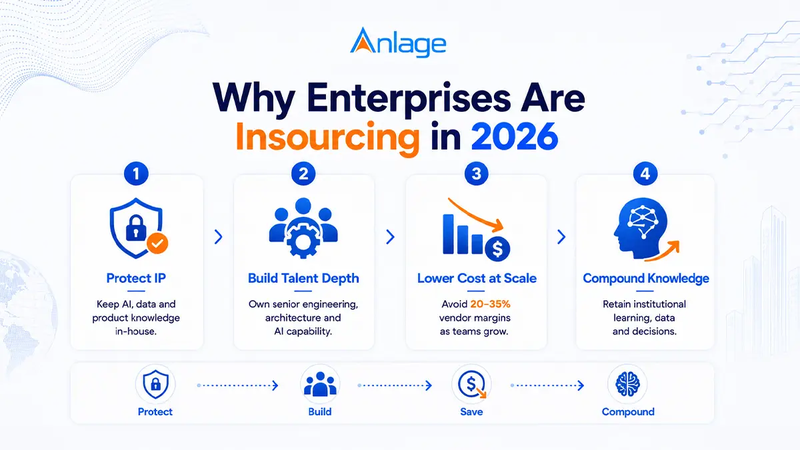
The insourcing trend is structural, not cyclical. Three forces are driving it simultaneously.
The AI and IP imperative. As AI becomes the defining competitive capability, enterprises are recognizing that the work generating the most strategic value — AI model development, data platform engineering, proprietary product development — cannot be safely delegated to third-party vendors. IP created through outsourcing is contractually transferred, but institutional knowledge, training data, and architectural decisions remain with the vendor team. Insourcing through a GCC keeps all of this inside the enterprise.
The talent depth problem. Outsourcing provides access to skills but not to talent depth. Vendor teams are organized around the vendor's delivery model, not the enterprise's strategic priorities. At scale, enterprises running mission-critical functions through outsourcing consistently encounter the same ceiling: the vendor's team knows enough to execute, but not enough to lead. Insourced GCCs, by contrast, build the institutional depth — senior engineers, architects, AI specialists — that compounds over time.
The cost economics shift. Outsourcing is cost-efficient at small scale and short duration. At 50+ people over 2–3 years, the captive economics consistently outperform outsourcing. The vendor margin — typically 20–35% on top of labor cost — compounds significantly at scale. The enterprises that insourced early are now running materially lower cost-per-outcome on the same functions they previously outsourced.
Why Outsourcing Remains Relevant
Despite the insourcing surge, outsourcing is not in retreat. The Deloitte Global Outsourcing Survey shows adoption of outcome-based outsourcing strategies rising from 45% to 67% in just two years — a signal that outsourcing is maturing, not declining. Three conditions consistently make outsourcing the right choice.
Variable-volume work. Functions with unpredictable demand — seasonal customer support spikes, project-based development, audit and compliance cycles — are structurally unsuited to captive headcount. Outsourcing provides elastic capacity that a fixed-headcount GCC cannot.
Commodity services. Payroll processing, basic IT support, facilities management, and other well-defined, repeatable functions deliver limited differentiation regardless of who runs them. Outsourcing these to specialized providers at lower cost is rational, and most enterprises that have strong insourcing programs still outsource their commodity operations deliberately.
Speed to market in new geographies. When an enterprise needs to hire in a new country within weeks — for a regulatory requirement, a market opportunity, or a product launch — outsourcing or EOR provides the fastest path. GCC setup, even via GCC-as-a-Service, requires 45–60 days minimum. For genuinely time-critical market entry, outsourcing wins on speed.
The Multidimensional Model: How Leading Enterprises Run Both
The most sophisticated operating models in 2026 are not choosing between insourcing and outsourcing — they are assigning each to the work it is structurally best suited for, with clear governance across the boundary.
The framework leading enterprises are applying looks like this:
Insource (GCC / captive): AI and data engineering, proprietary product development, IP-sensitive technical functions, core engineering teams, senior talent in strategic roles, and any function where institutional knowledge compounds into competitive advantage over time.
Outsource: Variable-volume operations, commodity services, specialist functions needed at low volume, market-entry hiring before a captive entity is established, and any function where the work is well-defined enough to be governed by SLA rather than culture.
AI-augmented delivery: The digital workforce — AI agents, automation bots, and intelligent process tools — is now a third sourcing model alongside insourcing and outsourcing. Deloitte's 2024 survey found 83% of executives leveraging AI as part of their outsourced services, and 20% already building digital workforce strategies for AI and automation bots.
The governance challenge in this model is the boundary management — ensuring that functions assigned to outsourcing do not drift into strategic territory, and that the captive GCC is not treated as a cost center when its mandate is capability building. For more on how to structure the captive vs outsourcing boundary, our analysis of shared services vs outsourcing and what a captive unit is covers both dimensions in detail.
What Enterprises Get Wrong in the Insourcing vs Outsourcing Decision
Treating it as binary. The question is not "insource or outsource" — it is "which functions to insource, which to outsource, and how to govern both." Enterprises that make a single strategic bet on one model pay for it when the model's limitations emerge at scale.
Insourcing too late. The optimal window to convert a large outsourced function to a captive GCC is when the team is 30–50 people and the mandate has become long-term and strategic. Enterprises that wait until the function is 200 people deep in a vendor relationship face switching costs — talent transition, knowledge transfer, vendor contract exits — that are significantly higher than if they had made the move earlier.
Outsourcing IP-sensitive work for cost reasons. Short-term cost savings from outsourcing AI development, core product engineering, or data platform ownership consistently underperform long-term — because the institutional knowledge created through that work remains with the vendor. Enterprises that have learned this lesson are insourcing these functions into GCCs regardless of the short-term cost premium.
Ignoring the governance layer. According to Deloitte, nearly 70% of organizations find their vendor management function still immature — unable to effectively govern the boundary between insourced and outsourced delivery. The multidimensional model requires active governance, not passive contract management.
For context on how GCCs specifically address the limitations of outsourcing, our guide on what a GCC is and the shared services guide are directly relevant starting points.
The Bottom Line
Insourcing and outsourcing are not opposites — they are complementary tools in a portfolio sourcing strategy that leading enterprises are designing deliberately rather than defaulting into. The enterprises generating the most durable competitive advantage are those that have insourced their strategic, IP-sensitive, and capability-building functions into captive GCCs, while continuing to use outsourcing for the variable, commodity, and speed-to-market work where it remains the right tool.
The binary framing — insource or outsource — is a 2010s question. The 2026 question is: which functions belong in your captive, which belong with a vendor, and how do you govern the boundary between them as both evolve?
How Anlage Digital Helps Enterprises Build the Right Model
Anlage Digital's GCC services are built for enterprises that have decided to insource strategically — and need the fastest, most reliable path to a captive capability center in India.
- Strategic advisory — mapping which functions to insource vs outsource based on mandate, team size, industry, and strategic timeline
- GCC-as-a-Service — standing up a captive GCC in under 60 days, covering entity formation, workspace, compliance, payroll, and talent acquisition
- Talent acquisition via Select10x — AI-powered hiring from a 30 million-strong database, finding best-fit engineers, data scientists, and AI specialists for the insourced function
- Outsourcing-to-GCC transition — managing the migration from vendor-run operations to captive ownership without disrupting delivery continuity
- Governance design — building the KPI frameworks and operating model that connect the GCC to enterprise leadership and govern the boundary with outsourced functions
With 28+ years of enterprise experience and 350+ GCCs delivered across BFSI, Retail, Healthcare, and Technology, Anlage has helped enterprises at every stage of the insourcing journey — from the first strategic advisory conversation to full captive ownership.
If your organization is evaluating whether to insource a function currently running through a vendor, talk to an Anlage expert — we will help you build the case and execute the transition.
Frequently Asked Questions
1. What is the difference between insourcing and outsourcing?
Insourcing means running functions internally with your own employees, retaining direct governance and IP ownership. Outsourcing means contracting a third-party vendor to run those functions, with the vendor employing and managing the workforce.
2. Is insourcing always better than outsourcing?
No — insourcing suits long-term, IP-sensitive, strategic work; outsourcing suits variable-volume, commodity, and speed-to-market functions. The right model depends on the function, team size, and timeline.
3. What is driving the insourcing trend in 2026?
The need to own AI and data IP internally, talent depth limitations of vendor teams at scale, and captive GCC cost economics beating outsourcing at 50+ people. Deloitte's 2024 survey confirmed GICs are surging as enterprises rebalance their talent ecosystems.
4. Can enterprises run insourcing and outsourcing simultaneously?
Yes — most leading enterprises do deliberately. Strategic functions go to captive GCCs; commodity and variable-volume functions go to outsourcing vendors, with active governance across the boundary.
5. What is multidimensional sourcing?
Multidimensional sourcing combines insourcing (GCCs), outsourcing (vendors), and AI-augmented delivery (bots and agents) in one deliberate operating model. Each is assigned to the work it is structurally best suited for.
Build Your Innovation GCC in India
Anlage has set up 350+ GCCs across Retail, BFSI, Healthcare, and Technology. We can have your first team operational in 60 days.
Start the Conversation