Recruiting has always been a people function. In 2026, it is also a data and AI function — and the enterprises that have not made that shift are already operating at a structural disadvantage. According to SHRM's State of AI in HR 2026 report, AI use across HR tasks climbed to 43% of organizations in 2026, up from 26% in 2024. Recruiting is now the single most common AI use case in HR, ahead of learning and development, performance management, and every other function.
The HR tech market reflects this urgency. The talent acquisition software market was valued at $10.37 billion in 2025 and is projected to reach $14.4 billion by 2031, according to Mordor Intelligence — driven by enterprise demand for AI-powered candidate matching, cloud-native HR platforms, and integrated talent orchestration that unifies sourcing, screening, and candidate relationship management in a single workflow.
For enterprise leaders — CHROs, CHOs, and talent acquisition heads — the question is no longer whether to invest in AI-powered HR tech. It is which capabilities to build, which to buy, and how to govern them without creating legal and reputational risk.
What is HR Tech?
HR tech refers to the software platforms, tools, and AI-powered systems that enterprises use to manage the full spectrum of human resources functions — from talent acquisition and onboarding to performance management, workforce planning, learning and development, and employee experience.
In the context of talent acquisition specifically, HR tech encompasses applicant tracking systems (ATS), AI-powered sourcing platforms, candidate assessment tools, interview scheduling automation, skills-based matching engines, and workforce analytics dashboards. The defining characteristic of modern HR tech is integration: the best platforms connect every stage of the hiring funnel into a unified data environment where decisions are driven by consistent, real-time signals rather than fragmented manual processes.
What has changed dramatically in the last two years is the role of AI within that stack. Earlier HR tech automated administrative tasks. Current HR tech makes substantive decisions — ranking candidates, predicting attrition risk, identifying skills gaps, and recommending hiring actions — with AI as the core decision layer, not a feature.
How AI is Reshaping Enterprise Talent Acquisition
The shift from conventional HR tech to AI-powered talent acquisition is not incremental. It is architectural. Here is where the transformation is happening and what it means for enterprise hiring teams.
AI-Powered Candidate Sourcing
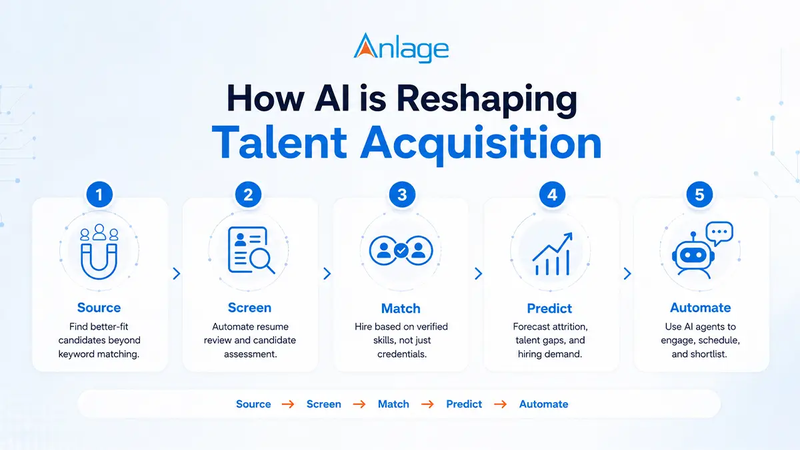
Traditional sourcing relies on job boards, recruiter networks, and inbound applications. AI-powered sourcing platforms scan talent databases, professional networks, and passive candidate pools at scale — identifying best-fit candidates based on skills, experience patterns, and predictive fit signals rather than keyword matching on a resume. The distinction matters: keyword matching finds candidates who describe themselves in the right terms; AI-powered matching finds candidates who have actually done the relevant work, regardless of how they describe it.
For enterprises hiring at volume — particularly GCCs building engineering, data, and AI teams in competitive geographies — the difference between keyword sourcing and AI-powered matching is measured in weeks of time-to-fill and meaningful improvements in first-year retention.
Resume Screening and Candidate Assessment
AI screening tools have replaced manual resume review at the top of the funnel for most enterprise recruiting teams. The best implementations go well beyond filtering for qualifications — they assess communication quality, identify skills adjacencies, flag potential culture fit signals, and score candidates against historical performance data from similar roles. According to SHRM's 2026 research, 92% of recruiting executives anticipate generative AI becoming more prevalent in content and candidate evaluation workflows, with 87% expecting broader AI automation across general recruiting processes.
The risk that accompanies this capability is real. The Workday lawsuit — a class action alleging AI screening tools discriminated on race, age, and disability, which a federal judge refused to dismiss in March 2026 — is a landmark signal for every CHRO deploying AI screening at scale. Governance and bias auditing are not optional features of enterprise HR tech deployments. They are prerequisites.
Skills-Based Hiring
Skills-based hiring has become the dominant recruiting paradigm in 2026. According to SHRM's Finding Talent report, 63% of organizations identify developing a critical talent sourcing strategy as their top priority — and that strategy is increasingly built around verified skills rather than credentials or job titles. Skills-based hiring reached 70% adoption among enterprise employers according to NACE data.
For HR tech platforms, this shift requires a skills ontology layer — a structured, continuously updated taxonomy of skills and their relationships — that can map candidate profiles to role requirements with precision. Platforms that still rely on title and tenure matching are functionally obsolete for the recruiting challenges enterprises face in 2026.
Predictive Workforce Analytics
The most mature HR tech deployments have moved from reporting to prediction. AI-powered workforce analytics platforms monitor attrition risk in real time, identify high-potential employees before they signal departure intent, model the impact of compensation changes on retention, and forecast talent demand against strategic business plans. These capabilities transform HR from a reactive function to a proactive one — and they depend on data quality, integration, and governance architecture that most HR tech stacks are still building toward.
Agentic AI in Recruiting
The frontier of HR tech in 2026 is agentic AI — systems that don't just respond to prompts but proactively execute multi-step recruiting workflows. An agentic AI recruiting system can autonomously identify candidates, initiate outreach, schedule interviews, follow up with applicants, and surface shortlists to hiring managers — compressing weeks of recruiter activity into hours. Early deployments show that TA professionals who actively integrate generative AI save a full working day per week, according to LinkedIn's 2025 Future of Recruiting research. As agentic capabilities mature, the productivity differential between AI-integrated and conventionally run recruiting teams will widen significantly.
The HR Tech Stack: What Enterprises Are Actually Building
Enterprise HR tech is not a single platform decision. It is a stack of integrated capabilities that need to work together coherently. The enterprises building genuine competitive advantage in talent acquisition are investing across four layers simultaneously.
Data foundation — a unified talent data platform that aggregates candidate data, employee records, skills assessments, performance data, and market intelligence into a single, queryable environment. Without this layer, every other HR tech investment is limited by data fragmentation.
AI and matching engine — the core intelligence layer that powers sourcing, screening, skills matching, and predictive analytics. This is where platform differentiation is sharpest and where governance requirements are highest.
Workflow and orchestration — the ATS and workflow automation layer that manages candidate pipelines, interview scheduling, offer management, and recruiter task management. Increasingly, this layer is where agentic AI is being deployed.
Analytics and reporting — the dashboard and insights layer that gives TA leaders, CHROs, and business unit heads visibility into hiring velocity, quality of hire, source effectiveness, cost per hire, and workforce planning metrics.
The Risks Enterprise Leaders Cannot Ignore
HR tech at enterprise scale introduces risks that are qualitatively different from those in consumer or SMB deployments.
Algorithmic bias and legal exposure — AI screening tools that produce discriminatory outcomes — intentionally or through training data bias — create significant legal liability under US employment law, GDPR, and emerging AI governance frameworks in the EU and UK. The Workday case has made clear that deploying AI screening at scale without bias auditing and explainability infrastructure is an unmanaged legal risk.
Data privacy and compliance — talent data is among the most sensitive data enterprises handle. HR tech platforms that aggregate candidate profiles, assessment results, and behavioral data must comply with GDPR, CCPA, and sector-specific regulations, and must have clear data retention and deletion policies embedded in their architecture.
Vendor dependency and data portability — enterprises that build their talent data environment inside a single vendor's closed platform face structural dependency. When talent data is locked in a vendor's system, switching costs become prohibitive and the enterprise loses control of its most valuable HR asset.
The Bottom Line
HR tech has moved from a productivity tool to a strategic capability — and the distance between enterprises that have built mature, AI-powered talent acquisition infrastructure and those still running conventional ATS-and-spreadsheet recruiting is growing. According to SHRM, 63% of organizations say talent sourcing strategy is their number one priority for 2026, in an environment where TA budgets are flat and recruiter headcount is not growing. AI is not the answer to every recruiting challenge — but for enterprises hiring at volume, in competitive geographies, for specialized roles, it is the only way to maintain hiring quality and velocity simultaneously.
The governance question matters as much as the capability question. The enterprises that will extract durable value from HR tech investment are those that build bias auditing, explainability, and data governance into the deployment from the start — not as afterthoughts.
How Anlage Digital's Select10x Helps Enterprises Hire Better
Select10x is Anlage Digital's AI-powered talent acquisition platform, built specifically for enterprises hiring at scale in competitive talent markets — including GCCs building engineering, data, and AI teams in India.
- AI-powered matching from a 30 million-strong talent database — identifying best-fit candidates based on verified skills and experience patterns, not keyword matching
- Skills-based candidate assessment — evaluating candidates against role-specific competency frameworks rather than titles and credentials
- Bias-aware screening — built-in governance and audit trails that reduce legal risk and improve hiring equity across candidate pools
- Agentic sourcing workflows — proactive candidate identification and outreach automation that reduces recruiter workload and compresses time-to-shortlist
- Workforce analytics — real-time visibility into pipeline health, source effectiveness, and hiring velocity for TA leaders and CHROs
- GCC-specific talent expertise — deep knowledge of India's engineering, data, and AI talent markets, with talent acquisition strategies built for GCC hiring velocity and talent management frameworks that reduce post-hire attrition
With 28+ years of enterprise experience and 350+ GCCs delivered, Anlage brings the talent market depth and AI infrastructure that enterprise-scale hiring demands.
If your organization is evaluating HR tech or building a talent acquisition capability for a GCC or enterprise expansion, talk to a Select10x expert to understand what AI-powered hiring looks like at your scale.
Frequently Asked Questions
1. What is HR tech?
HR tech refers to software platforms and AI-powered tools enterprises use to manage HR functions — from talent acquisition and workforce planning to performance management. Modern HR tech uses AI as the core decision layer, not just for administrative automation.
2. How is AI changing talent acquisition in 2026?
AI has shifted talent acquisition from keyword-based filtering to skills-based matching, predictive assessment, and agentic workflows. According to SHRM, 43% of organizations used AI for HR tasks in 2026, up from 26% in 2024, with recruiting as the top use case.
3. What are the risks of using AI in HR tech?
The primary risks are algorithmic bias creating legal liability, data privacy failures, and vendor lock-in. The 2026 Workday lawsuit — alleging AI screening tools produced discriminatory outcomes — is the clearest signal that governance matters as much as capability.
4. What is skills-based hiring?
Skills-based hiring evaluates candidates on verified competencies rather than credentials or job titles. It reached 70% adoption among enterprise employers in 2026 and requires an HR tech platform with a structured skills ontology to match candidates to roles with precision.
5. What should enterprises look for in an HR tech platform?
Enterprises should prioritize AI-powered skills matching, bias auditing, data portability, and HRIS integration. Platforms that unify sourcing, screening, assessment, and analytics in one data environment deliver far more value than disconnected point solutions.
Build Your Innovation GCC in India
Anlage has set up 350+ GCCs across Retail, BFSI, Healthcare, and Technology. We can have your first team operational in 60 days.
Start the Conversation