
The way enterprises design, build, and deliver products has fundamentally changed. Digital engineering is the discipline that sits at the center of that change — integrating software, data, AI, and cloud-native development practices into the entire product lifecycle, from concept to deployment to continuous improvement. It is not a tool or a platform. It is a way of building that replaces sequential, document-heavy development with an interconnected, data-driven approach where physical and digital representations of a product evolve together in real time.
According to the Zinnov Digital Engineering Report 2024, the global digital engineering market was valued at $2.21 trillion in 2023 and is projected to reach $3 trillion by 2027 — growing at a 13% CAGR even through macroeconomic headwinds. For enterprise leaders, this is not a technology trend to evaluate at a distance. It is a strategic capability that is actively reshaping competitive dynamics across manufacturing, BFSI, healthcare, automotive, and retail.
What is Digital Engineering?
Digital engineering is the application of digital technologies — including cloud-native software development, AI, data analytics, digital twins, simulation, IoT, and automation — across the full lifecycle of product and system development. It replaces fragmented, handoff-driven engineering processes with an integrated, model-based approach where every stakeholder works from a single, continuously updated digital representation of the product.
The term is closely related to Engineering Research and Development (ER&D) and is sometimes used interchangeably with digital product engineering. What distinguishes digital engineering from conventional software development is its scope: it spans the entire product lifecycle — from requirements and design through development, testing, deployment, and operational feedback — and it applies equally to physical products, software systems, and the infrastructure that runs them.
At its core, digital engineering is what happens when enterprises stop treating technology as a support function and start treating it as the product itself.
Why Digital Engineering Has Become a Strategic Priority
The shift to digital engineering is being driven by three converging pressures that enterprise leaders in 2026 cannot engineer around.
Products are becoming software. Across automotive, industrial equipment, medical devices, and consumer electronics, the competitive differentiation that once came from physical design is now delivered through software. A car's value is increasingly determined by its software-defined features. A medical device's capabilities are defined by its AI algorithms. An industrial machine's efficiency is determined by its predictive maintenance software. Digital engineering is the capability required to build, update, and continuously improve these software-defined products at the speed markets demand.
Development cycles have compressed irreversibly. The enterprise that takes 18 months to go from concept to deployment will not compete with the one that takes 6. Digital engineering practices — agile development, continuous integration and deployment, simulation-based testing, API-first architecture — are what enable the faster cycle. According to Zinnov's analysis, enterprise digital engineering spend is on an upswing driven by CXOs prioritizing operational efficiency, cost reduction, and the adoption of advanced technologies including AI, analytics platforms, and automation tools.
Legacy architecture is becoming a competitive liability. Monolithic applications, on-premise infrastructure, and waterfall development processes are not just inefficient — they actively prevent enterprises from deploying AI, scaling cloud capabilities, and integrating with the partner ecosystems that modern product delivery requires. Digital engineering is the discipline that enables the transition from legacy architecture to cloud-native, modular, and AI-ready systems without disrupting operational continuity.
Core Components of Digital Engineering
Digital engineering is not a single practice — it is a capability stack. The enterprises building genuine digital engineering competencies are investing across all of these layers simultaneously.
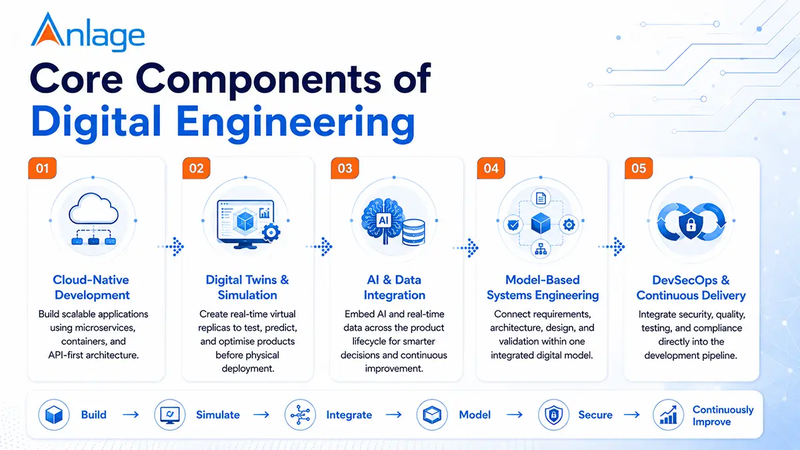
Cloud-Native Application Development
Digital engineering starts with building applications that are designed for cloud infrastructure from the ground up — using microservices architectures, containerization, and API-first design patterns that allow components to scale, update, and integrate independently. This is the foundational layer that everything else depends on. Applications that cannot be independently deployed and updated cannot be continuously improved.
Digital Twins and Simulation
A digital twin is a real-time virtual replica of a physical product, system, or process — continuously updated with data from the operational environment. Digital engineering uses digital twins to simulate product behavior before physical prototyping, test modifications without production risk, and monitor performance in the field. Manufacturing enterprises using digital twins in product development report 20–30% reductions in time-to-market. For capital-intensive industries — automotive, aerospace, industrial equipment — digital twin capability is increasingly a prerequisite for competitive product development.
AI and Data Integration Across the Product Lifecycle
Digital engineering embeds AI not as a feature but as a layer — in quality inspection, predictive maintenance, personalization, demand forecasting, and operational optimization. The distinction from conventional AI adoption is integration: AI capabilities are built into the product architecture and the development workflow, not bolted on after the product is deployed. This requires data pipelines that capture operational telemetry in real time and feed it back into the product development cycle.
Model-Based Systems Engineering (MBSE)
MBSE replaces document-heavy, linear systems engineering with a model-centric approach where system requirements, architecture, design, and verification are all managed within a single integrated model. For complex systems with multiple interdependent subsystems — an autonomous vehicle, a medical device, an industrial control system — MBSE provides the coordination layer that allows large teams to work in parallel without losing system coherence.
DevSecOps and Continuous Delivery
Digital engineering requires that security and quality are embedded in the development pipeline from the first line of code — not tested at the end. DevSecOps practices integrate automated security testing, compliance verification, and performance monitoring into the CI/CD pipeline, allowing enterprises to ship faster without accumulating security debt. For regulated industries — BFSI, healthcare, defense — this is not optional: it is the architecture required for continuous delivery under regulatory scrutiny.
Digital Engineering in Practice: Industry Applications
Automotive
Software-defined vehicles are the defining application of digital engineering in automotive. A modern vehicle contains over 100 million lines of code — more than a commercial aircraft. Digital engineering practices allow automotive enterprises to develop, test, and deploy vehicle software through continuous delivery pipelines, update features over-the-air after sale, and simulate millions of driving scenarios without physical test vehicles. Volkswagen, BMW, and Tesla have all restructured their engineering organizations around digital engineering principles.
Healthcare and Medical Devices
Digital engineering enables medical device companies to compress regulatory submission timelines through model-based testing and simulation, build AI-diagnostic capabilities directly into device firmware, and maintain continuous post-market surveillance through device telemetry. The integration of digital engineering with regulatory compliance — particularly FDA and MDR requirements — is one of the most technically complex applications in the discipline.
BFSI
Banks and financial institutions use digital engineering to modernize core banking platforms, build API ecosystems that enable open banking integration, and deploy AI-powered risk and compliance systems. The banking sector is projected to allocate over 40% of its IT budget to digital transformation by 2025, a large portion of which flows into digital engineering services — re-platforming legacy cores, building cloud-native payment infrastructure, and integrating real-time analytics into customer-facing products.
Manufacturing and Industrial
Digital engineering in manufacturing centers on smart factory transformation: connecting OT and IT systems, deploying AI-powered quality inspection, building predictive maintenance infrastructure on top of IoT sensor data, and implementing digital twin simulations of production lines. Industry 4.0 and Industry 5.0 initiatives across Germany, Japan, South Korea, and India are fundamentally digital engineering programs at industrial scale.
The Talent Imperative in Digital Engineering
Digital engineering capability cannot be acquired through software licenses. It is built through people — specifically, people who combine engineering domain knowledge with cloud-native development skills, AI fluency, and data engineering competency. This combination is rare, in high demand, and disproportionately concentrated in a small number of geographies globally.
India has emerged as the primary talent ecosystem for enterprise digital engineering capability. The country's engineering graduate output — 2.5 million STEM graduates annually — combined with a maturing GCC ecosystem that has been building digital engineering competencies for over two decades, makes India the most viable location for enterprises looking to build captive digital engineering capacity at scale. For enterprises evaluating how to build their digital engineering capability, understanding how to set up a captive engineering unit in India is a critical first step. For those focused on the R&D dimension specifically, our analysis of building high-performance R&D centers in India's GCC ecosystem covers the operating model in detail.
The Bottom Line
Digital engineering is not a capability enterprises can defer. The competitive gap between organizations that have built genuine digital engineering competency and those still running sequential, document-heavy development processes is already visible in time-to-market, product quality, and the ability to integrate AI — and it is widening. The $3 trillion trajectory Zinnov projects for global digital engineering spend by 2027 reflects a market that has already made its decision: digital engineering is how products get built now.
For enterprise leaders, the question is not whether to invest in digital engineering capability — it is how to build it at the speed the market requires, with the talent depth the discipline demands.
How Anlage Digital Helps Enterprises Build Digital Engineering Capability
Anlage Digital's application development practice is built around the full digital engineering stack — from cloud-native architecture and DevSecOps pipelines to AI integration, digital twin development, and legacy application modernization.
- Cloud-native application development — designing and building microservices-based, API-first applications that can scale, update, and integrate at the speed modern product delivery requires
- Legacy modernization — re-platforming monolithic applications to cloud-native architectures without disrupting operational continuity, using phased migration approaches that manage risk throughout
- AI and data integration — embedding AI capabilities into the product development lifecycle and building the data pipelines that allow operational telemetry to feed back into engineering decisions
- Digital twin and simulation — building virtual replicas of physical products and production systems that enable simulation-based testing and real-time operational monitoring
- DevSecOps implementation — integrating security, quality, and compliance verification into CI/CD pipelines, enabling continuous delivery in regulated industries
- Digital engineering talent — sourcing cloud-native developers, AI engineers, data architects, and systems engineers through Select10x from a 30 million-strong talent database
With 28+ years of enterprise technology experience and delivery teams operating across BFSI, Healthcare, Retail, and Manufacturing, Anlage brings the engineering depth and operating discipline that building a digital engineering capability at scale demands.
If your organization is evaluating how to build or accelerate your digital engineering capability, talk to an Anlage expert to understand what the right approach looks like for your specific environment and timeline.
Frequently Asked Questions
1. What is digital engineering?
Digital engineering is the application of software, AI, data, and cloud-native practices across the full product lifecycle — from design through deployment and continuous improvement. It replaces sequential, document-driven development with an integrated approach where physical and digital representations evolve together.
2. What is the difference between digital engineering and software engineering?
Software engineering focuses on building software applications. Digital engineering is broader — spanning physical and software products alike, integrating AI, simulation, IoT, and cloud infrastructure across the entire product lifecycle.
3. What is a digital twin in digital engineering?
A digital twin is a real-time virtual replica of a physical product or system, continuously updated with operational data. It allows teams to simulate behavior, test changes without production risk, and monitor performance before and after deployment.
4. Why is India a hub for digital engineering talent?
India produces 2.5 million STEM graduates annually and has a mature GCC ecosystem with two decades of digital engineering experience. The combination of talent volume, cost structure, and depth in cloud-native and AI engineering makes it the most viable location for enterprise-scale digital engineering.
5. How do enterprises start building digital engineering capability?
The most practical starting point is an honest assessment of the current application estate — identifying where legacy architecture or waterfall practices are constraining delivery speed. From there, a phased modernization program addresses gaps without disrupting operational continuity.
Build Your Innovation GCC in India
Anlage has set up 350+ GCCs across Retail, BFSI, Healthcare, and Technology. We can have your first team operational in 60 days.
Start the Conversation