
Enterprise technology investment has never been higher — and the returns have never been more uneven. The global digital transformation market was valued at $1.3 trillion in 2025 and is projected to reach $5.5 trillion by 2033, according to Grand View Research. Yet McKinsey's 2025 State of AI survey found that despite nearly 90% of organizations regularly using AI in at least one function, only 5.5% report greater than 5% EBIT impact from their transformation programs.
The gap between investment and impact is not a technology problem. It is a prioritization and sequencing problem. Enterprises that are seeing measurable returns from digital transformation technologies are not deploying everything simultaneously — they are building in the right order, on the right foundations, with the right governance. This article examines the digital transformation technologies that are delivering the most measurable enterprise value in 2026, and what it takes to deploy them effectively.
What Are Digital Transformation Technologies?
Digital transformation technologies are the tools, platforms, and infrastructure that enable enterprises to fundamentally change how they operate, deliver value, and compete — replacing manual, disconnected, and legacy processes with integrated, data-driven, and automated systems.
The term covers a broad spectrum: cloud infrastructure, artificial intelligence, data engineering platforms, IoT, automation, and application modernization. What distinguishes digital transformation technologies from conventional IT investment is intent — these are not tools that make existing processes marginally more efficient. They are technologies that change the operating model itself, enabling enterprises to do things that were structurally impossible before.
The enterprises extracting the most value from digital transformation technologies in 2026 share one characteristic: they treat technology adoption as an architectural decision, not a procurement decision. The sequence matters. The integration matters. The data foundation matters more than any individual tool.
The Top Digital Transformation Technologies Enterprises Are Deploying in 2026
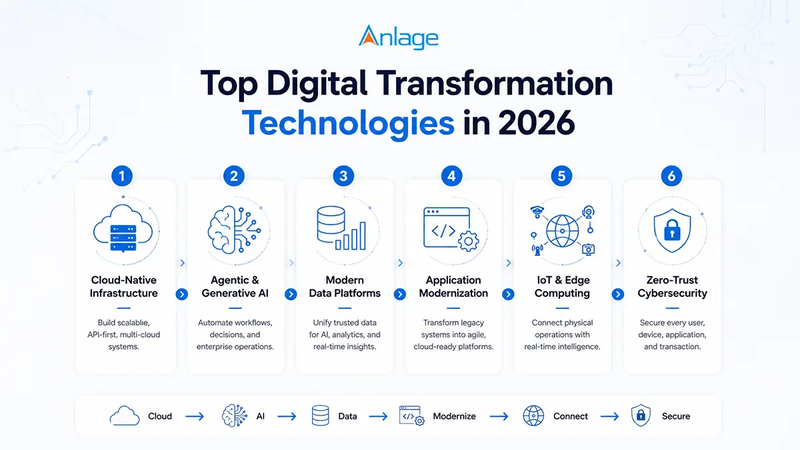
1. Cloud-Native Infrastructure and Multi-Cloud Architecture
Cloud is no longer a digital transformation technology in the aspirational sense — it is the foundational layer that every other digital transformation technology runs on. By 2027, more than 50% of enterprises are expected to deploy industry-specific cloud platforms, according to Gartner. What has evolved significantly in 2026 is the architecture: enterprises have moved from cloud migration (moving existing workloads to the cloud) to cloud-native design (building systems that are architected for cloud from the start).
Cloud-native infrastructure — built on microservices, containerization, API-first design, and serverless compute — gives enterprises the ability to deploy new capabilities independently, scale specific components without rebuilding entire systems, and integrate with partner ecosystems through open APIs. Multi-cloud strategies, where enterprises distribute workloads across AWS, Azure, and GCP based on capability and cost, have become the default architecture for large enterprises managing regulatory, performance, and vendor concentration risks simultaneously.
The practical implication for enterprise leaders: cloud infrastructure is not a one-time migration project. It is an ongoing architecture discipline that requires dedicated cloud engineering capability and continuous cost and performance optimization.
2. Agentic AI and Generative AI
Generative AI moved from pilot to production across enterprise functions in 2024–2025. In 2026, the frontier has shifted to agentic AI — systems that don't just respond to prompts but autonomously execute multi-step workflows, make decisions, and take actions across enterprise systems without human intervention at each step. According to Gartner, 40% of enterprise applications will embed task-specific AI agents by end of 2026, up from less than 5% in 2024.
The enterprise applications generating the most measurable value are concentrated in a few areas: AI-assisted software development (where code generation tools are reducing development time by 30–40% in structured environments), intelligent document processing (automating extraction and routing of unstructured data from contracts, invoices, and regulatory filings), customer service automation (where agentic AI handles multi-turn conversations and resolution workflows without escalation), and supply chain intelligence (where AI models optimize inventory, routing, and demand forecasting in real time).
The critical success factor is data quality. McKinsey's research identifies data quality and availability as the primary barrier to AI value, cited by 72% of enterprise leaders. Enterprises that deploy AI without first building the data infrastructure that feeds it consistently underperform those that sequence data engineering investment before AI deployment.
3. Data Engineering and Modern Data Platforms
Data engineering has moved from a back-office function to a strategic capability. The enterprises generating competitive advantage from digital transformation technologies are those that have built unified data platforms — data lakehouses, real-time streaming pipelines, and governed data products — that make high-quality, trusted data available to every AI model, analytics tool, and operational system across the enterprise.
The dominant architectural pattern in 2026 is the data lakehouse: a platform that combines the low-cost storage and flexibility of a data lake with the query performance, ACID compliance, and governance capabilities of a data warehouse. Platforms including Databricks, Snowflake, and Microsoft Fabric have made lakehouse architecture accessible to enterprises that previously required separate systems for storage and analytics.
Data mesh — a decentralized approach where individual business domains own and publish their data as products — is gaining adoption in large enterprises where central data teams have become bottlenecks. The governance question in data mesh is significant: without federated governance standards, decentralized ownership creates data quality and compliance risk. Enterprises adopting data mesh successfully are those that have invested in the governance layer before decentralizing ownership.
4. Application Modernization and Legacy Migration
Legacy application estates are the single largest drag on enterprise digital transformation velocity. Monolithic applications built on aging architectures cannot integrate with modern AI and data platforms, cannot be updated at the speed digital business requires, and accumulate technical debt that compounds the cost of every subsequent technology investment.
Application modernization — re-platforming, re-architecting, or rebuilding legacy systems on cloud-native foundations — is one of the most active areas of enterprise technology investment in 2026. Upgrading or replacing outdated IT systems is a priority for 34% of organizations actively pursuing digital transformation, according to market research. The enterprises doing this most effectively are using a strangler fig approach: gradually replacing legacy components with modern equivalents while maintaining operational continuity, rather than attempting big-bang rewrites that carry high execution risk.
AI-assisted modernization tools are materially changing the economics of legacy migration. AI-driven COBOL-to-Java conversion has reached 93%+ accuracy in structured environments, reducing the effort and cost of migrating mainframe-era code by an order of magnitude compared to manual rewriting.
5. IoT and Edge Computing
IoT and edge computing connect the physical and digital worlds — enabling enterprises to capture real-time data from physical assets, processes, and environments, and act on it at the point of generation rather than routing everything to a central cloud. In manufacturing, IoT sensors embedded in production equipment generate the telemetry that feeds predictive maintenance AI models. In logistics, GPS and condition-monitoring sensors track shipment status, temperature, and handling in real time. In retail, computer vision systems at the edge enable real-time inventory tracking and customer behaviour analytics.
The shift from IoT-as-data-collection to IoT-as-operational-intelligence is what makes it a genuine digital transformation technology in 2026. Enterprises that have moved beyond basic sensor telemetry to AI-at-the-edge deployments — where inference runs on the device, not in the cloud — are achieving sub-millisecond response times for quality control, safety monitoring, and autonomous operations that cloud-dependent architectures cannot match.
6. Cybersecurity and Zero-Trust Architecture
Digital transformation creates attack surface. Every cloud migration, API integration, and AI deployment expands the perimeter that needs to be defended. Zero-trust architecture — where no user, device, or system is trusted by default, and every access request is continuously verified — has become the security framework of choice for enterprises running distributed, multi-cloud, AI-powered technology estates.
Cybersecurity is not typically categorized as a digital transformation technology, but it is the prerequisite that determines whether transformation programs can be sustained. Enterprises that have built zero-trust security into their cloud and data architecture from the start are significantly more resilient to breach and significantly faster to recover when incidents occur.
What Separates Enterprises That Transform from Those That Stall
The data is clear that technology investment alone does not produce transformation outcomes. The enterprises that are generating measurable returns from digital transformation technologies share a set of operating disciplines that are as important as the tools themselves.
They sequence investments correctly — data infrastructure before AI, cloud-native architecture before application modernization, governance before scale. They treat integration as a first-order design requirement — every new technology must connect to the enterprise data environment and the existing application estate from day one. And they build internal capability rather than outsourcing everything — the enterprises that have maintained competitive digital transformation velocity are those that own core engineering, data, and AI competencies in-house, whether through internal teams or captive GCC structures, rather than depending entirely on third-party vendors.
For more context on how digital transformation technologies are reshaping enterprise delivery models, our analysis of how global business services are powering digital transformation and the innovations reshaping the global delivery model in India cover the operating model dimensions in detail.
The Bottom Line
The digital transformation technologies that are generating measurable enterprise value in 2026 are not new — cloud, AI, data platforms, and application modernization have been on enterprise roadmaps for years. What is different in 2026 is that the gap between enterprises that have built genuine capability in these areas and those still running pilots is becoming structurally visible in cost, speed, and competitive position.
The sequencing insight is the most practically useful one for enterprise leaders: data quality before AI deployment, cloud-native architecture before application modernization at scale, and governance before decentralization. Enterprises that get the sequence right are the ones producing the 5%+ EBIT impact that distinguishes genuine transformation from expensive experimentation.
How Anlage Digital Helps Enterprises Deploy Digital Transformation Technologies
Anlage Digital's cloud services, AI services, and data engineering practices are built around the full digital transformation technology stack — from cloud-native infrastructure and data platform design to AI deployment, application modernization, and managed operations.
- Cloud architecture and migration — designing and building multi-cloud, cloud-native infrastructure on AWS, Azure, and GCP, with FinOps discipline embedded from day one
- AI and agentic AI deployment — building and operationalizing AI models across enterprise functions, with data quality assessment and governance built into the deployment architecture
- Data platform engineering — designing and implementing data lakehouses, real-time pipelines, and governed data products on Databricks, Snowflake, and Microsoft Fabric
- Application modernization — re-platforming legacy estates to cloud-native architectures using phased, risk-managed approaches that maintain operational continuity throughout
- Managed cloud and data operations — running the technology infrastructure after deployment with continuous optimization, security monitoring, and performance management
- GCC build for digital engineering — setting up captive engineering centers in India for enterprises that want to own their digital transformation technology capability long-term
With 28+ years of enterprise experience and delivery teams operating across BFSI, Retail, Healthcare, and Manufacturing, Anlage brings the technical depth and operating discipline that deploying digital transformation technologies at enterprise scale demands.
If your organization is evaluating which digital transformation technologies to prioritize and how to sequence them for maximum impact, talk to an Anlage expert to map the right approach for your environment.
Frequently Asked Questions
1. What are digital transformation technologies?
Digital transformation technologies are tools and platforms — cloud, AI, data engineering, IoT, and application modernization — that enable enterprises to change how they operate and compete. They replace legacy, manual processes with integrated, automated systems that change the operating model itself.
2. Which digital transformation technology delivers the most ROI?
Cloud-native infrastructure delivers the broadest ROI as the foundation every other digital transformation technology runs on. AI delivers the highest upside but only when data quality is fixed first — enterprises that skip this step consistently underperform.
3. Why do most digital transformation programs fail to deliver impact?
McKinsey found only 5.5% of organizations report meaningful EBIT impact from AI despite near-universal adoption, with data quality as the top barrier. Most programs stall because they treat technology as a procurement decision rather than an architectural one.
4. What is the difference between cloud migration and cloud-native?
Cloud migration moves existing workloads to cloud infrastructure; cloud-native means building systems from the ground up using microservices, containers, and APIs. Cloud-native architectures deliver significantly more agility and cost efficiency than lifted-and-shifted legacy systems.
5. How do enterprises prioritize digital transformation technologies?
The most effective sequence is cloud infrastructure first, then data platform and governance, then AI on top of clean data, then application modernization. Enterprises that deploy AI before fixing their data infrastructure consistently fail to generate measurable returns.
Build Your Innovation GCC in India
Anlage has set up 350+ GCCs across Retail, BFSI, Healthcare, and Technology. We can have your first team operational in 60 days.
Start the Conversation